Ask most traders why they’re not profitable yet and you’ll hear about strategy: the wrong indicator, a system that needs more backtesting, a market that’s stopped behaving the way it used to. Look at the actual research on who wins and who loses, though, and strategy barely gets a mention. The regulators and academics who’ve measured this properly, across different decades, different countries, and completely different market structures, keep landing on the same answer, and it isn’t a strategy problem.
Just how bad the numbers are
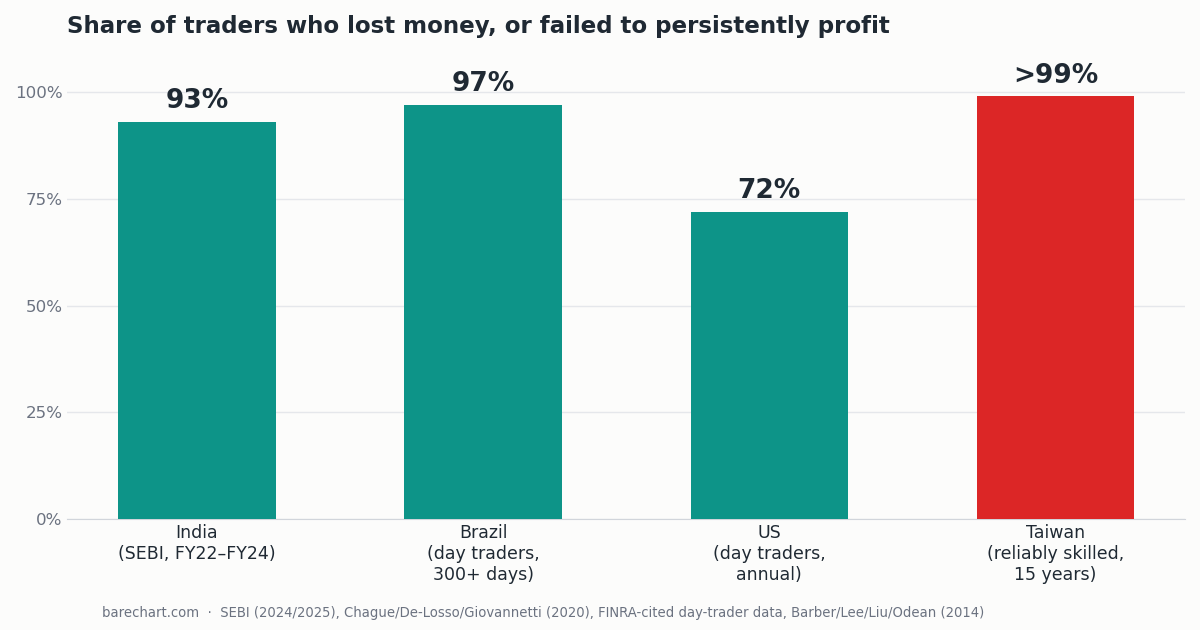
India’s securities regulator, SEBI, studied every individual trader in the equity derivatives segment and found 93% of them lost money between FY22 and FY24, with aggregate losses topping ₹1.8 lakh crore over the three years. The top 3.5% of loss-makers, around four lakh traders, lost an average of ₹28 lakh each. A follow-up study covering FY25 found the picture had got worse, not better: 91% of traders lost, and the total net loss rose 41% to ₹1,05,603 crore. The tell that this isn’t just inexperience is buried in the same data: more than three-quarters of the loss-making traders kept trading anyway, without stepping back to learn from the loss, and lost again.
Brazil tells a similar story with better long-term tracking. Researchers followed nearly 20,000 people who started day-trading mini-Ibovespa futures and isolated the 1,551 who stuck with it for more than 300 days, long enough to rule out beginner’s luck either way. Of that group, 97% lost money, and the probability of turning a profit fell the longer someone kept trading, the opposite of what you’d expect if experience were the missing ingredient. The authors compared the whole exercise to roulette.
Taiwan’s 15-year dataset of day traders, one of the most cited studies in this field, found under 1% of the day-trading population could reliably beat the market net of fees. Genuine skill turned up in the data, the top 500 traders in a given year went on to earn a real, persistent edge, but most of the roughly one in five day traders who profited in any single year got there on luck, not on anything repeatable. And in the US, Barber and Odean’s landmark study of over 66,000 households found the most active traders earned 11.4% a year while the market itself returned 17.9%, most of the gap explained by turning over three-quarters of their holdings annually in commissions and slippage, and FINRA-cited data put the share of day traders finishing the year at a loss at around 72%.
Four countries, three decades, and every kind of market structure you could point at as an excuse, thin liquidity, algorithmic competition, retail-only participation, and the loss rate barely moves, which points at what happens inside a trader’s head as the real decider of the outcome, not the tools or the access they’re trading with.
The same handful of habits keep showing up
Across the behavioural finance literature, a small set of documented biases explains most of it. The disposition effect, first named in the 1980s and confirmed in the decades after across the US, Israel, Finland, China, and Sweden, describes traders selling their winners too early and holding their losers too long, the exact reverse of what a sound approach requires. Overconfidence shows up as overtrading: Barber and Odean found men traded 45% more than women and earned 1.4% less a year for it, with single men trading 67% more than single women. The trading itself, done past a certain point, is the drag, not the edge some of it was meant to capture.
Loss aversion sits underneath both. A loss hurts more than an equivalent gain feels good, so a losing position gets held well past the point a trader said they’d cut it, in the hope it turns around before they have to admit the mistake on paper. FOMO, revenge trading after a loss, confirmation bias, anchoring to a price that no longer means anything, herding into whatever’s already moved: different names for a familiar pattern, and every one of them shows up more often the moment real money, not a demo account, is at risk.
What the traders who don’t lose do differently
Mark Douglas, whose books shaped a lot of modern trading psychology, argued consistency comes from mindset before it comes from more analysis. Treat an edge as a higher probability over a large sample, never a promise on the next trade, and stop equating a single loss with personal failure, because that’s what produces the hesitation and the early exit that make the following trade worse too.
Brett Steenbarger frames trading as a performance discipline closer to elite sport than to investing: improvement comes from deliberate practice and structured self-review, not from putting on more trades. He adds an important qualifier to the discipline advice above: rigid discipline can lock in a poor result if the market itself has changed underneath a trader’s rules. Adaptation carries as much weight as consistency, and frustration, in his framing, is what pushes a trader to adapt in the first place.
Van Tharp puts position sizing ahead of almost everything else, including the entry. His well-known marble-game exercise runs an identical, positive-expectancy setup through a room of participants and ends with some of them bankrupt, purely from how aggressively they sized each bet, same edge, same trades, wildly different outcomes. And Denise Shull argues against suppressing emotion altogether: the useful skill isn’t feeling nothing, it’s naming precisely what you’re feeling and why, then controlling the behaviour that follows instead of trying to switch the feeling off.
Is psychology overrated?
Not everyone agrees mindset is the main event. A vocal counter-argument holds that what separates good traders from average ones is edge and risk management, full stop, and that managing your emotions without a real edge just means losing more slowly and with better manners. There’s something to that: no amount of composure turns a negative-expectancy system into a profitable one.
The honest answer sits between the two camps. Profitability needs three things at once: a real positive-expectancy edge, position sizing that survives a losing streak without wiping the account, and the discipline to execute both consistently when a setup is screaming at you to break your own rules. Psychology is necessary without being sufficient on its own. Edge without discipline evaporates over enough trades, and discipline without edge just loses more slowly, which is the same counter-argument above, reframed as one leg of a three-legged stool instead of the whole thing.
Make it measurable
All three legs share one weakness: none of them are visible from inside your own head while you’re trading. A journal is what turns them into something you can check. Logged over enough trades, it proves whether an edge is real instead of relying on the handful of wins a trader happens to remember. It puts the risk rules on paper where a bad decision can’t be quietly waved through in the moment. And it’s the only reliable way to catch the psychology, the hesitation on a good setup, the size creeping up after a win, the stop moved once “just this time”, because none of that shows up on a chart. It only shows up in a record of what you did.
That’s the answer to the trader blaming their strategy at the start of this piece. The data says the strategy is rarely the weak link. What’s harder to see, and rarely checked honestly, is what happens between a good setup appearing and a trader’s hand pulling the trigger on it.
Nothing on this page is financial advice. The studies referenced measure historical trader outcomes and don’t predict any individual’s results.