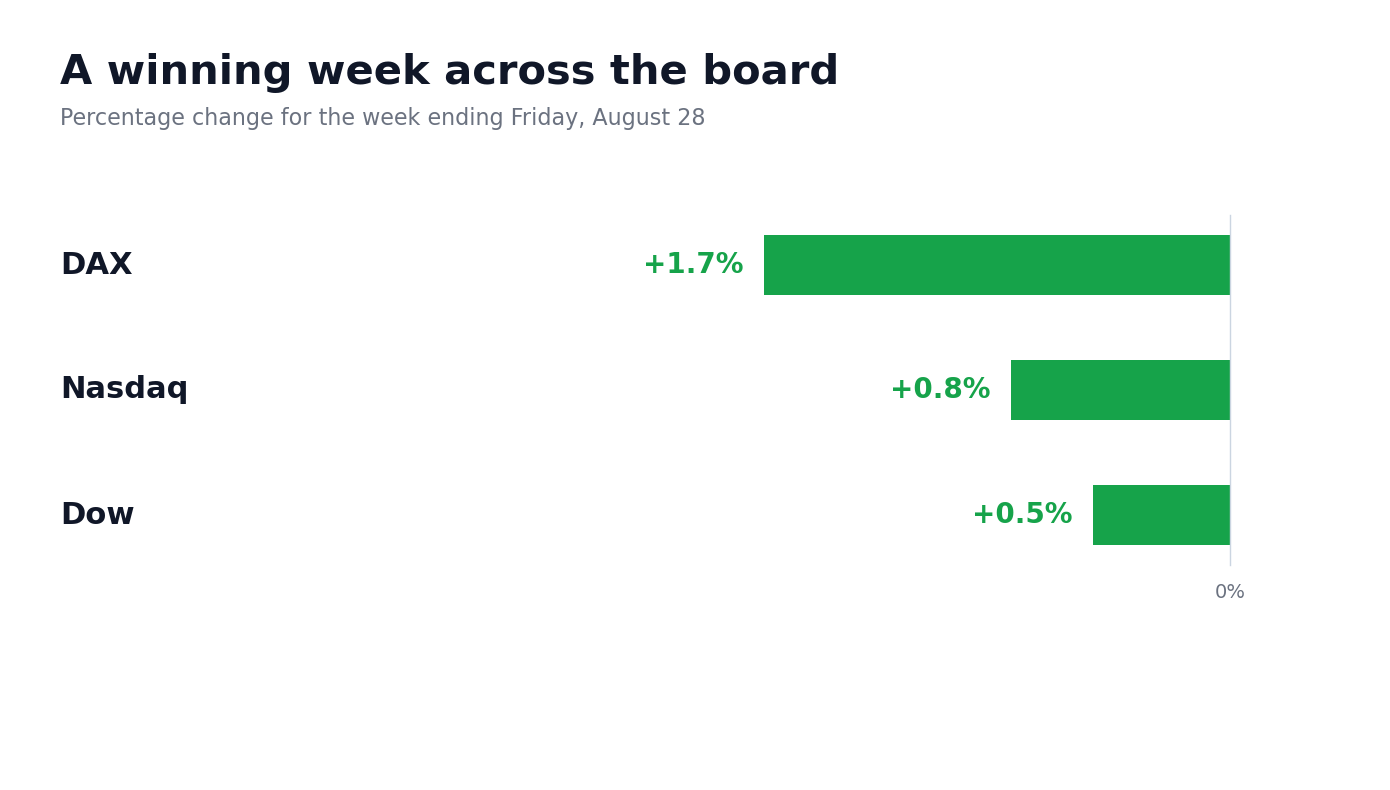
Last week ended the way this Fed cycle keeps ending: with markets moving more on what a policymaker said than on anything a data release showed. New Fed chair Kevin Warsh used his first Jackson Hole keynote on Friday, marking his hundredth day in the job, to say he isn’t convinced inflation’s underlying trend has improved even after a run of better-than-expected summer prints, and traders responded by pushing the odds of a September rate hike up to 55.7%, about twenty percentage points higher than the day before. All three indices closed the week higher regardless, DAX out in front on an automaker-led Friday rally that pushed it to a fresh all-time high, while Dow and Nasdaq both remain a little below their own record levels. The real test of whether Warsh’s tone holds up lands Friday, when August’s jobs report either backs up his inflation concerns or repeats July’s shock 23,000 miss and undoes the very odds his speech just built.
In focus
DAX
The DAX did the heavy lifting for the week, pushing to a fresh all-time high on Friday and adding 1.7% to close at 26,570. Automakers led the board that day, BMW rose 4.50%, Volkswagen 3.23%, and Mercedes-Benz 2.96%, catching a bid as traders weighed what a more hawkish Fed under Warsh might mean for a stronger dollar and steadier export pricing for Germany’s carmakers.
That record leaves the DAX with no prior price history overhead, a position that cuts both ways: nothing left to slow a continuation, but also nothing there to catch the index if the automaker rally runs out of buyers. Tuesday’s final German and eurozone August manufacturing PMI is the week’s real test of whether the move has fundamental legs behind it. The flash reading already surprised well to the upside, Germany’s provisional print came in at 54.1, up from 52.2 in July and the strongest since May 2022, driven by inventory rebuilding, rising defence spending, and data-centre investment. A confirmed final print anywhere near that would give the index a domestic reason to keep pushing toward the 27,000 mark instead of just riding the US rates story everyone else is trading; a downward revision would leave a fresh record high with nothing behind it right as the rest of the week’s risk, Wednesday’s Beige Book and Friday’s payrolls, turns on US rate expectations.
Dow
The Dow barely moved on Friday, essentially flat at 53,559.99, enough for a 0.5% weekly gain but still around 1.5% below its own record of 54,349.12 set earlier in August.
The gap to that high is really a bond-market story. The 2-year Treasury yield jumped roughly 8 basis points to 4.31% on Friday, its highest since late July, as Warsh’s Jackson Hole remarks were read as opening the door wider to a hike than markets had priced going into the week; the 10-year added 4 basis points to 4.72% and the 30-year 2 to 5.21%. That’s the kind of broad move across the curve that usually weighs on rate-sensitive blue chips, though Venezuela-linked energy and industrial names picked up the slack on Friday, Halliburton gained more than 2% and Chevron rose 0.9% on reports of expanded oil dealings there, and could keep doing so if those headlines stay live. Two events this week decide which way that balance tips: Wednesday’s Fed Beige Book, the central bank’s own read on regional conditions ahead of the September meeting, and Friday’s nonfarm payrolls, landing directly against the 55.7% hike odds Warsh’s speech just built. A soft print, anything close to July’s 23,000 shock, would likely pull yields back down and put the record high back in play; a strong one hardens the hike case and makes 54,349 a much harder level to reclaim.
Nasdaq
The Composite added 0.8% on the week even after giving back 0.52% on Friday to close at 26,402.42. Most of the gain came Wednesday, when Nvidia’s blowout second-quarter earnings lifted the whole chip complex, before PayPal’s collapsed takeover (down more than 12% after Stripe and Advent walked away from a reported $50 billion deal) and a Marvell earnings miss took some of it back on Friday.
That leaves the index around 1.5% below its own record of 26,803.03, set in mid-August, a gap Wednesday’s Nvidia rally nearly closed before Friday’s stock-specific selling reopened it. Nothing on the calendar touches the Nasdaq directly until Thursday’s ISM Services PMI, but Friday’s payrolls report is the one that decides the retest: rate-sensitive growth names took the hardest hit of any group we cover from Friday’s yield spike, so a hot jobs print that cements higher hike odds would keep that pressure on and push the record further out of reach, while a soft one removes the main obstacle standing between here and a new high.
Elsewhere this week
Gold kept climbing even as yields rose against it, a combination that doesn’t usually go together: rising real yields normally make a non-yielding asset like gold less attractive, yet it’s holding near $4,600 an ounce and on track for its biggest monthly gain since 1999. The likely explanation is that Warsh’s own words are doing double duty: a Fed chair openly saying inflation’s underlying trend hasn’t improved is the kind of signal that keeps a longer-term inflation hedge attractive, even while the short-term rates story argues the other way. Oil had a more straightforward week: WTI rose 2.54% on Friday to $85.52 a barrel, with Halliburton and Chevron’s Friday gains part of the same story, reports that Venezuelan oil dealings are expanding, a new supply-side wrinkle layered on top of the Iran-linked tension that had already been pushing crude higher through most of August. Bitcoin and EURUSD were both quieter, with the dollar side of the pair mostly tracking the same rate-hike repricing hitting every other asset this week, not anything specific to the eurozone.
The calendar
Today is quiet by comparison to what follows, no major US data due, leaving markets to keep digesting Friday’s speech and yield move. Tuesday brings the week’s first real test: the US ISM Manufacturing PMI and July’s JOLTS job openings figure, alongside the final read on Germany and the eurozone’s August manufacturing PMIs, both of which came in well above forecast on the flash release. Wednesday adds July factory orders and the Fed’s own Beige Book, its regional-conditions survey published ahead of every meeting and one of the few inputs the committee produces itself instead of reading off a data terminal. Thursday brings weekly jobless claims and the ISM Services PMI, the services-sector counterpart to Tuesday’s manufacturing read and historically the bigger swing factor for growth given how much of the US economy it covers. Friday is the week’s real event: August’s nonfarm payrolls report and the unemployment rate, arriving a week to the day after Warsh’s Jackson Hole keynote and landing directly against the 55.7% September hike odds it built. July’s payrolls missed badly, just 23,000 against a forecast for 80,000, and that miss is a big part of why hike odds had drifted so low before Friday’s speech reset them. Whether August’s number confirms Warsh’s read on inflation or repeats July’s weakness decides whether this week’s rate-hike repricing survives into the September Fed meeting.
Nothing on this page is financial advice. Levels and views here are a starting point for your own analysis, not a signal to trade.