US markets are shut today for Labor Day, so nothing moves until Tuesday. Once trading resumes, the week comes down to two releases: Thursday’s PPI and Friday’s CPI, both landing just days before the Fed’s 16 September rate decision. Friday’s stronger-than-expected jobs report already pushed the odds of a hike higher, and with Fed officials now in their pre-meeting blackout period, this week’s inflation data is the last real input anyone gets before that decision.
Last week
Friday’s nonfarm payrolls report was the story of the week: the US added 162,000 jobs in August against a forecast of around 53,000, while unemployment held at 4.1%. Normally that reads as an unambiguous positive, but with the Fed weighing a hike rather than a cut this cycle, a stronger labour market cuts the other way, it strengthens the case for higher rates, and higher rates weigh on equity valuations. Traders shorthand this as “good news is bad news,” and that’s what played out on Friday.
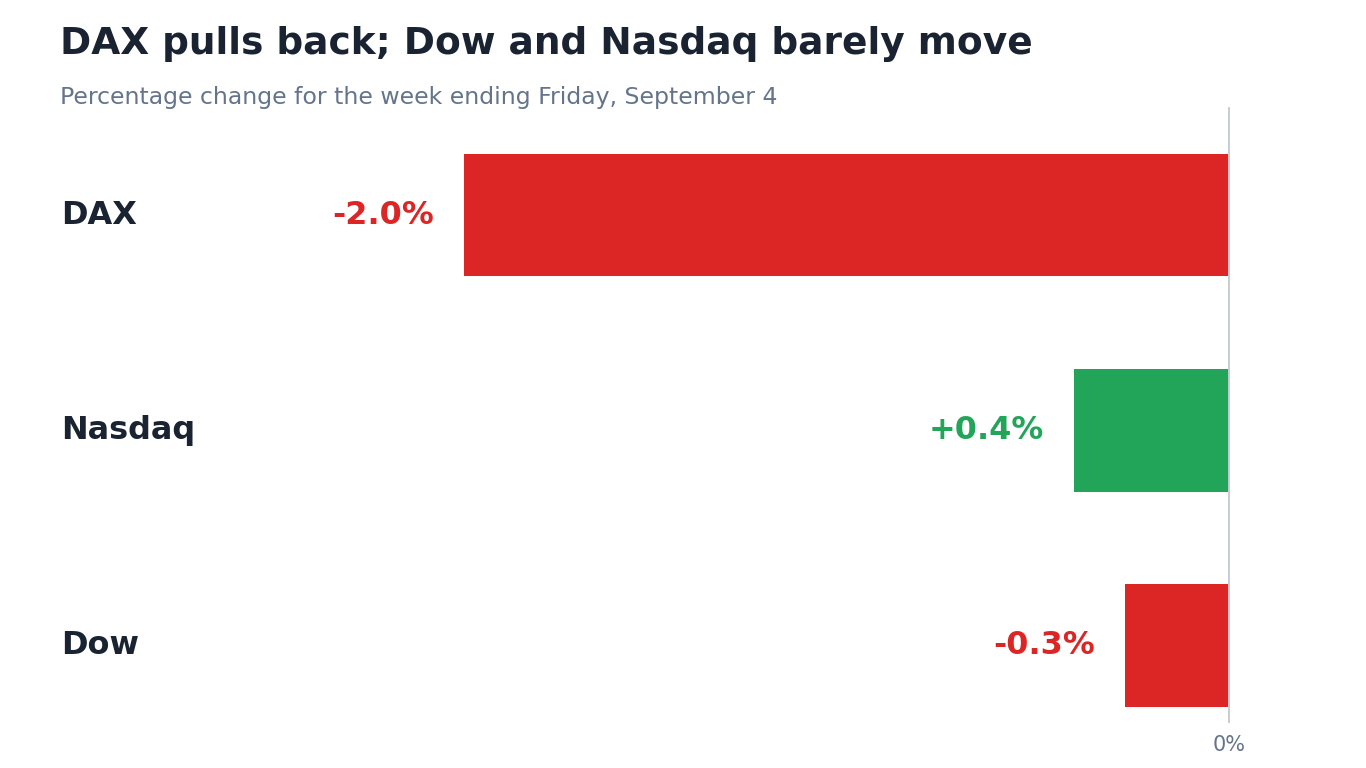
The DAX had the roughest week of the three, down about 2% to close at 26,046, adding its own bout of profit-taking to the global reaction. The Dow slipped a smaller 0.3% to 53,414, while the Nasdaq Composite squeezed out a 0.4% gain to close at 26,507, even after giving some of it back on Friday itself.
The week ahead
DAX
The DAX goes into this week sitting roughly in the middle of a range it’s held for a fortnight, support around 25,900 and resistance around 26,500, with Friday’s close of 26,046 almost exactly between the two. Nothing German-specific is due this week, so the index is trading off the same US inflation numbers as everything else. A clean break above 26,500 opens the door back towards its old highs; a slide under 25,900 says the pullback has further to run.
Dow
The Dow has more room either way: support around 52,700, and the level to beat is its own record high of 54,349, set back in August. Friday’s close of 53,414 sits closer to that record than to the floor, so this is arguably the index with the most riding on the data. With Fed officials in blackout, Thursday’s PPI and Friday’s CPI are the only real inputs left before the 16 September decision. A soft pair makes the case for rates staying put and probably gives the Dow a run at that record; a hot pair strengthens the case for a hike and makes 54,349 harder to break.
Nasdaq
The Nasdaq Composite’s own record high is 26,803, set in mid-August, with a support shelf around 26,000 it’s leaned on more than once over the past month. Friday’s close of 26,507 sits comfortably between the two. Rate-sensitive growth names are usually the first to move on shifting hike odds, since more of their value sits in profits still years out, so the Nasdaq is the index to watch hardest around Thursday and Friday’s prints: a soft set helps it push on towards a new record, a hot set likely hits it harder than either of the other two.
Elsewhere this week
Oil is the other big thread running through this week, and it isn’t about the calendar at all. About a quarter of the world’s oil moves by tanker through the Strait of Hormuz, and that route has been badly disrupted since a conflict between the US, Israel, and Iran broke out earlier in the year. A fresh exchange of strikes over the past few days, including the US hitting Iranian tankers after two other vessels came under attack, has kept that risk firmly on the table, and Brent crude was trading near $96 a barrel on Friday as a result. Until that calms down, oil is likely to keep reacting to headlines out of the Gulf more than to anything on an economic calendar.
Gold eased back to around $4,477 an ounce, a pullback after a strong run, as the same rise in rate-hike odds that hit shares made a non-yielding asset like gold less appealing by comparison. EURUSD held around 1.1614, and with the ECB not meeting again this month, its direction this week is a dollar story, it’ll likely move on whatever Thursday’s and Friday’s US inflation data does to the dollar rather than on anything happening in Europe. Bitcoin sat around $81,100, broadly tracking the same cautious mood as everything else.
The calendar
Monday is a US bank holiday (Labor Day), so American markets are shut. Tuesday brings NFIB’s small-business confidence survey, rarely a market-mover on its own. Wednesday is quiet again, a natural pause before the two releases that matter. Thursday is the Producer Price Index (PPI), out before the US open. Friday is the main event: the Consumer Price Index (CPI), also before the open. Both land inside the Fed’s blackout period ahead of its 16 September meeting, so they’re the last real evidence anyone gets before that decision, with no policymaker speeches left to lean on in between.
Nothing on this page is financial advice. Levels and views here are a starting point for your own analysis, not a signal to trade.