Everything else this week is just waiting for Wednesday afternoon. That’s when the Fed announces its rate decision, a few hours after August’s retail sales figures come out the same morning, and because policymakers stop giving speeches or interviews in the fortnight before every meeting, there’s nothing else on the calendar that comes close to mattering as much. Last week’s inflation figures came in higher than expected, and that alone was enough to tip the balance: traders now think the Fed is more likely than not to raise rates, where a week ago it was closer to an even bet. Wednesday is where we find out whether that shift was the right call.
Last week
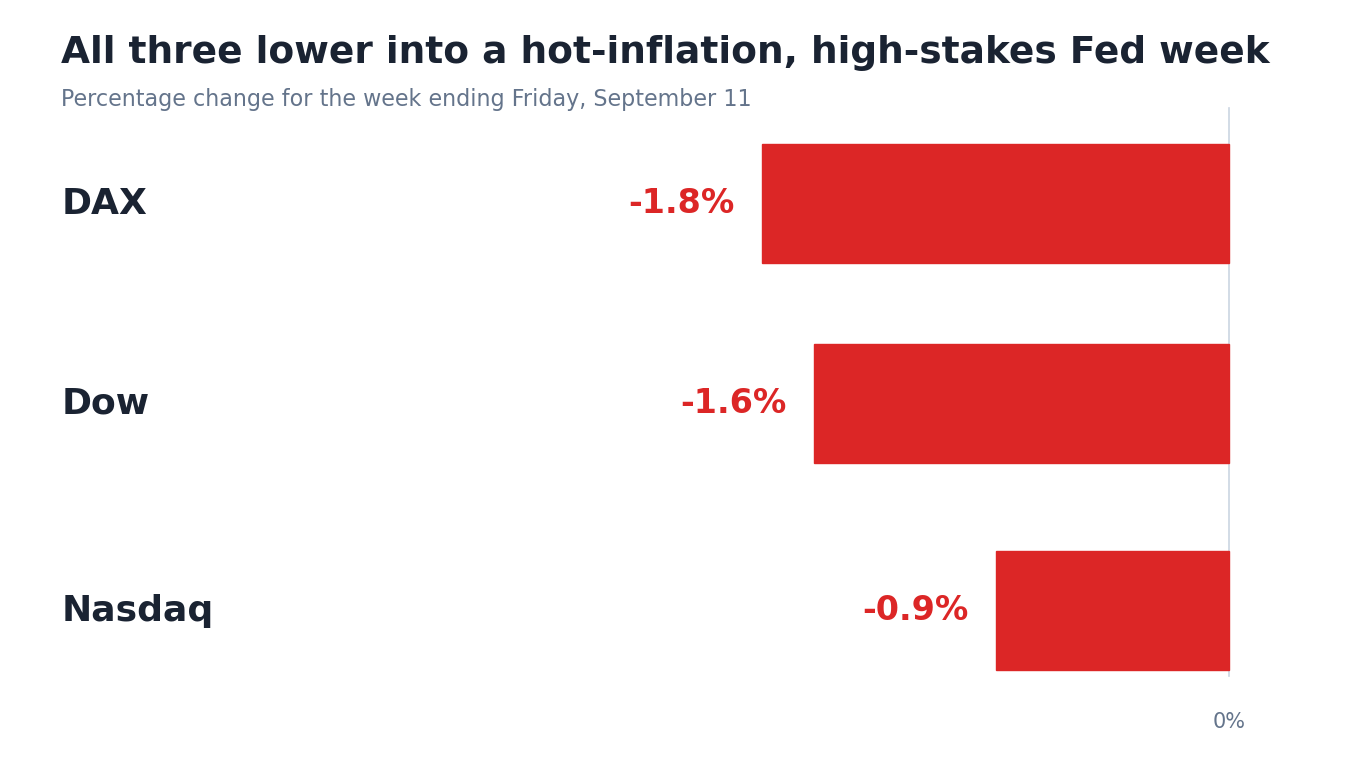
Both of August’s big inflation reports came in higher than expected. Producer prices rose 0.4% on the month, with the yearly rate climbing to 5.4%, and consumer prices came in a touch firmer than forecast too, core inflation up 0.3%. Numbers like that make it easier for the Fed to justify raising rates rather than holding steady, and all three indices ended the week lower because of it, even with a strong rally on Friday itself. The DAX lost 1.8% to close at 25,569, the Dow gave up 1.6% to 52,573.29 despite adding more than 500 points on Friday alone, and the Nasdaq Composite came off 0.9% to 26,333.04. President Trump has also been openly pushing Fed chair Kevin Warsh to cut rates instead of raising them, which hasn’t changed the numbers but has added a layer of noise to a decision that was already close to balanced.
The week ahead
DAX
The DAX is sitting right on a support level around 25,300, a floor it’s bounced from before, with the 25,900 to 26,000 area it broke down through last week now working the other way as a ceiling. There’s nothing German-specific due this week, so the index will simply follow whatever the US rate decision does to sentiment everywhere else. If the Fed surprises everyone and holds rates steady, that old ceiling around 26,000 could come back into play quickly; if it raises rates as most now expect, the DAX is more likely to keep drifting down toward 25,300 and below.
Dow
The Dow has support around 52,000, a round number sitting just under Friday’s close, and its own record high of 54,349 still standing overhead as the level to beat. Banks and industrial companies are the parts of this index that move most on a decision like Wednesday’s, because higher rates squeeze borrowing costs right across the economy. A hold, or even a smaller rise in rates than expected, would likely send the Dow back toward that record; a rise delivered exactly as expected might do surprisingly little damage, given how much of it the market has already braced for since last week’s inflation numbers came out.
Nasdaq
The Nasdaq Composite has leaned on a support shelf around 26,000 more than once over the past month, with its mid-August high of 26,803 sitting above as resistance - still short of the index’s actual record, set back in June. This is the index with the most riding on Wednesday, because a large part of what a fast-growing tech company is worth today depends on profits it hasn’t made yet, and those future profits are worth less the more expensive borrowing becomes. A hold would likely spark the strongest bounce of the three; a rise in rates, even one everyone saw coming, still confirms that money costs more from here.
Elsewhere this week
Oil has stopped listening to the economic calendar altogether. The exchange of strikes between the US and Iran around the Strait of Hormuz flared up again last week, pushing Brent crude above $100 a barrel and WTI close to $92, and that story is likely to keep driving energy prices regardless of what the Fed decides on Wednesday. Gold, oddly, slipped to a one-month low near $4,319 an ounce even while that conflict was escalating, a reminder that a stronger dollar and higher bond yields can outweigh gold’s usual appeal as a safe place to park money when a big rate decision is close. EURUSD is trading cautiously into Wednesday for the same reason: a rise in rates would likely push the dollar higher still, while a hold would probably help the euro’s recent recovery along. Bitcoin dropped below $77,000 as the same nervous mood spread into crypto.
The calendar
Monday and Tuesday are quiet compared with what follows, with Fed officials still keeping silent ahead of the meeting and nothing major due either day. Wednesday is the week’s real event: August’s retail sales figures at 8:30am ET, then the Fed’s rate decision at 2pm ET, the first time this cycle that a rise in rates has looked more likely than not going in. Thursday brings a busy calendar on paper, weekly jobless claims, housing starts and building permits for August, the Philly Fed’s manufacturing survey, September’s early PMI readings, and the Conference Board’s leading indicators, but all of it will most likely trade in Wednesday’s shadow. Friday is quiet again, giving markets a full day to work through whatever the Fed decided before the weekend.
Nothing on this page is financial advice. Levels and views here are a starting point for your own analysis, not a signal to trade.