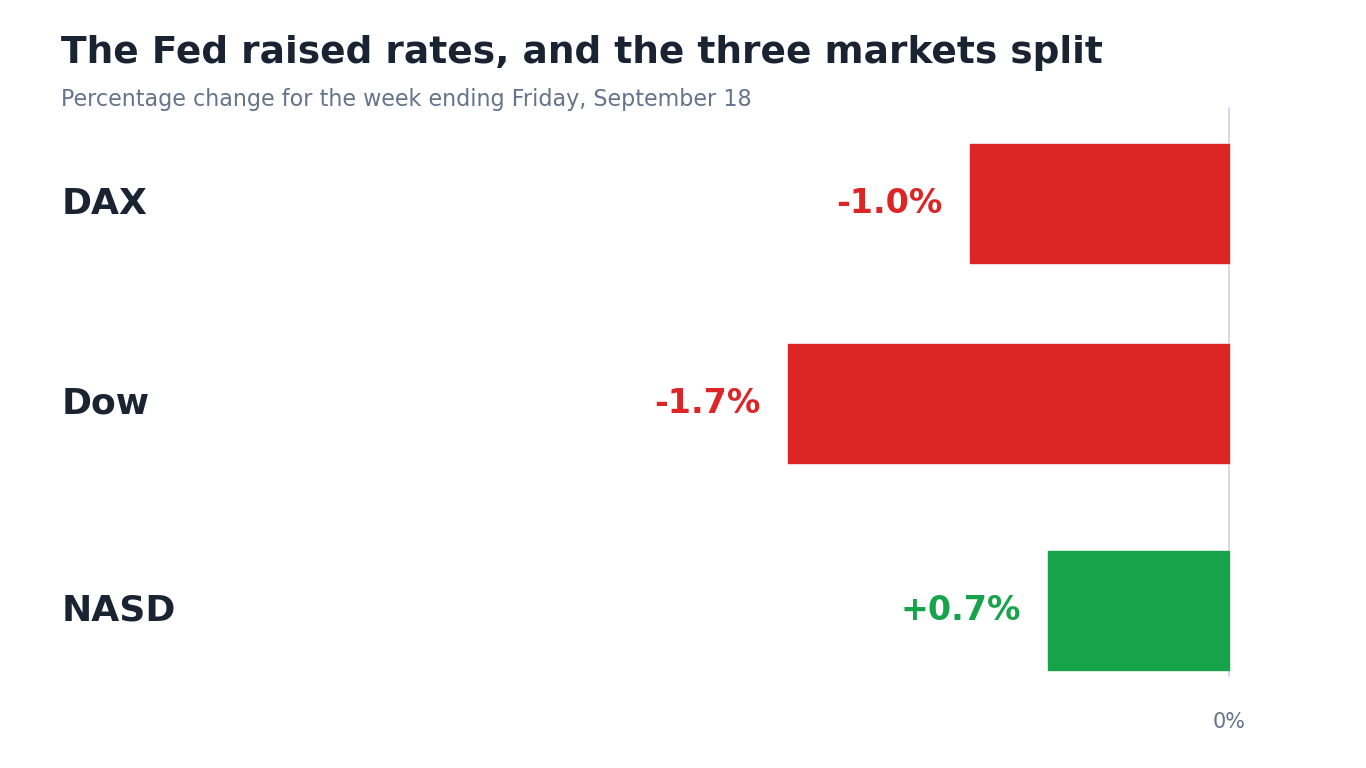
The Fed did what the market had been pricing in for weeks: on Wednesday it raised its main interest rate by a quarter point, to a range of 3.75-4.00%, the first time it’s raised rates since 2023. What happened next is the more interesting part. Government bond yields pushed above 5% for the first time in almost two decades, which weighed hard on Dow and DAX, while NASD brushed the whole thing off and finished the week higher. That split, not the rate rise itself, is the story going into this week.
Last week
Dow lost 1.7% to close at 51,682.64, its third straight weekly fall and its worst week since March, as rising bond yields made borrowing costlier right across the economy and Friday’s “triple witching” derivatives expiry added some extra swings on top. DAX fell 1.0% to 25,304, dragged down on Friday by a sharp drop in German carmakers. NASD, by contrast, gained 0.7% to 26,522.55, helped by a firm close on Friday that shrugged off the same yield pressure knocking the other two indices lower.
The week ahead
DAX
DAX is sitting right on support around 25,250, with 25,900 acting as the ceiling above it - a level that spent most of the summer as resistance before briefly flipping to support last month. There’s little Germany-specific news due this week, so the index is likely to keep tracking the same yield-driven mood as Wall Street. A slip below 25,250 would open the door to further declines; a recovery back above 25,900 would suggest last week’s fall was more about Friday’s one-off volatility than a real change in trend.
Dow
Dow has support around 51,200 and resistance around 52,275, with its record high of 54,349 still standing well above both. Rate-sensitive sectors, like banks and industrials, are the ones most likely to keep reacting to where bond yields settle this week. If yields ease back from above 5%, Dow has room to recover toward that resistance band; if they hold or climb further, last week’s losing streak could easily extend into a fourth week.
NASD
NASD is caught between support around 26,123 and a resistance band from 26,676 to 26,856 that’s turned back every serious rally since the spring. Clearing that band would put the index’s all-time high, set back in June, back in sight; failing there again would mean giving back Friday’s gains and then some. This is the index with the most riding on how comfortable investors feel about paying up for future profits now that money costs more to borrow.
Elsewhere this week
Oil pushed even higher last week: Brent crude touched $103.87 a barrel and WTI crossed $100 for the first time in this run, both still driven by the standoff over shipping through the Strait of Hormuz, not anything to do with the Fed. Gold recovered from the one-month low it hit the previous week, rising to $4,383 an ounce as falling oil prices eased some inflation worry, even with a firmer dollar working against it. The dollar itself stayed firm after the rate rise, with EURUSD easing to around 1.1483. Bitcoin recovered further too, trading back above $81,000 after dipping below $77,000 the week before.
The calendar
This week is unusually light on scheduled data but unusually heavy on people talking: more than ten Federal Reserve officials are due to give speeches, now that the meeting itself is out of the way and they’re free to comment again. Monday and Tuesday carry little beyond that string of appearances and Tuesday’s eurozone consumer confidence reading. Wednesday brings the flash reading of September’s US manufacturing PMI. Thursday has the regular weekly jobless claims figure. Friday closes the week with August’s durable goods orders. With the rate decision itself already delivered, how various Fed officials talk about what comes next is likely to move markets more than any of this week’s actual releases.
Nothing on this page is financial advice. Levels and views here are a starting point for your own analysis, not a signal to trade.