Friday’s jobs report did what the Fed had been worrying about it wouldn’t. Employers added just 29,000 jobs in September, far below the roughly 84,000 to 90,000 economists had expected, and unemployment ticked up to 4.2%. That cooled the bets on another rise in interest rates, and NASD rallied hard into the close, touching a new all-time intraday high before settling just short of its record close. Dow and DAX both finished the week lower, though, and bond yields were still high enough to keep the mood cautious.
Last week
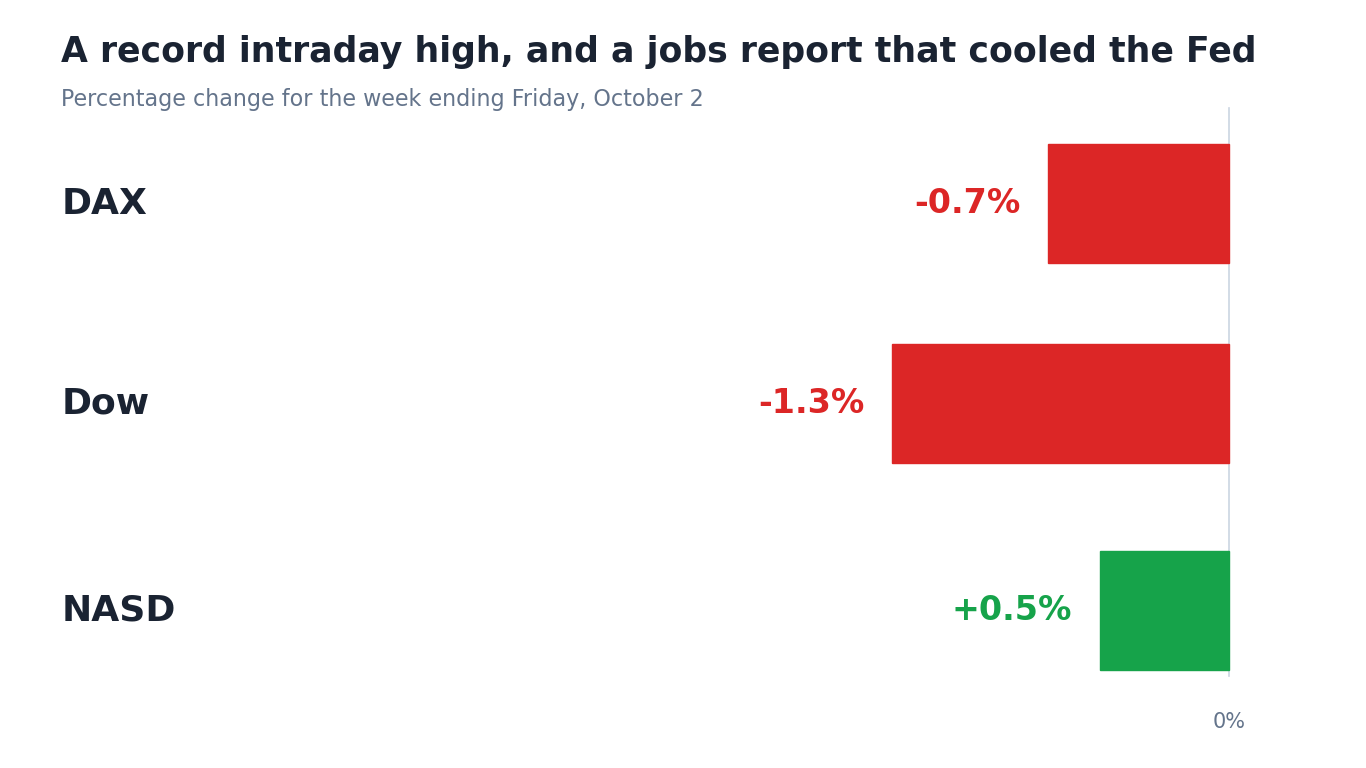
NASD gained 0.5% to close at 27,190.86, its intraday peak of 27,353.68 coming in the first hour of Friday’s session. Its closing record is still 27,244.28, so that remains the level to beat on a closing basis. Dow fell 1.3% to 51,143.70, while DAX slipped 0.7% to 25,222.05 despite a 1.1% gain on Friday itself. Revisions to August’s jobs figure, now 133,000, made the September miss look even more pronounced.
The week ahead
DAX
DAX has support around 24,830 and resistance around 25,616. Friday’s bounce brought it back up to that ceiling, which it tested twice this week without closing above. There’s little Germany-specific news due this week, so the index will mostly follow Wall Street’s reaction to the Fed minutes on Wednesday. A close above 25,616 would open the door back toward the 25,800s; a slip below 24,830 would bring the late-September lows back into view.
Dow
Dow has support around 50,530 and resistance around 51,770, with its record high of 54,349 still well above both. Dow lagged the rally on Friday, so it has more room to catch up if yields keep easing. Banks and industrials remain the sectors most sensitive to where borrowing costs settle, which makes Wednesday’s Fed minutes the event to watch. Clearing 51,770 would signal the index is starting to recover some of its lost ground.
NASD
NASD has support around 26,815 and resistance around 27,460, with its closing record of 27,244 the level that matters most on a close. Friday’s intraday record of 27,354 shows buyers were willing to push it higher, but the close below the record means the rally still needs confirmation. Losing 26,815 would suggest the bounce is running ahead of itself. A close above 27,244 would be the clearest sign the move has real staying power, since the index last closed at that level on 22 September and has been below it since.
Elsewhere this week
Oil held near $102 a barrel for Brent and around $91 for WTI, with the Strait of Hormuz standoff still the main driver. Gold eased back to roughly $4,170 an ounce, well down from last week, as the softer jobs data did little to lift it against a firm dollar. Bitcoin climbed to around $84,600, holding its recent gains. EURUSD slipped to about 1.1250 as the dollar stayed firm on the rate outlook.
The calendar
This is a quieter week for data, which puts more weight on the few releases there are. Monday brings the US ISM services PMI for September at 10:00 am New York time, where forecasts sit near 55, slightly below the previous reading. Wednesday is the big one: the Fed’s minutes from its September meeting, which will show how officials weighed the rate rise against the cooling jobs picture. Thursday has the ECB’s monetary policy accounts. Friday closes with Canadian employment and the US consumer sentiment reading. After a jobs report that softened the outlook for further rate rises, how the minutes read on the next move will likely matter more than any headline figure this week.
Nothing on this page is financial advice. Levels and views here are a starting point for your own analysis, not a signal to trade.