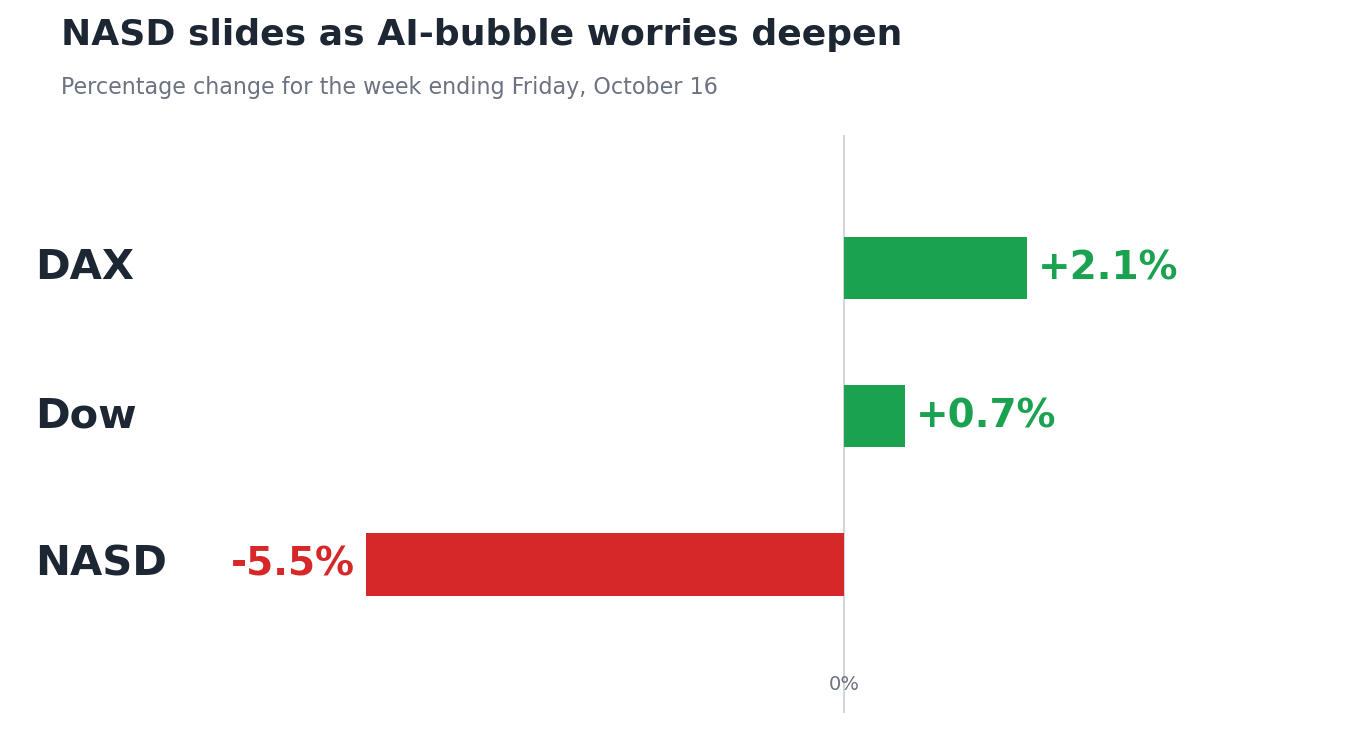
Wednesday’s inflation report was the week’s turning point. September’s consumer prices rose 3.7% year on year, hotter than the 3.6% forecast, and that was enough to revive worries about another Fed rate rise just as investors were already nervous about how much money has been poured into AI infrastructure and how exposed US chipmakers are to Chinese competition. Chip stocks bore the brunt of it, and NASD (the Nasdaq-100) never really recovered even as Thursday brought a partial rebound. DAX and Dow told a different story: both held up far better, and DAX actually finished the week higher, carried by defence and auto stocks rather than anything to do with inflation at all.
Last week
NASD fell 5.5% to close at 29,187.55, one of its roughest weeks in months, as Micron dropped 5.6% and Intel lost 5.8% on Friday alone on the broader chip-stock selloff. Dow added 0.7% to 52,002.41, with energy stocks helping cushion the broader tech-led weakness. DAX gained 2.1% to 25,622.42, helped by Rheinmetall’s 6.1% jump as European leaders met in Brussels to reaffirm support for Ukraine, plus solid gains for BMW, Mercedes-Benz and Volkswagen on hopes of more flexible EU emissions rules.
The week ahead
DAX
DAX has support around 25,520 and resistance around 25,730, with its record high of 26,630 further above. Last week’s strength came from company-specific stories, defence and autos, rather than anything macro, so the index looks better placed to shrug off a rough week on Wall Street than it would in a typical risk-off move. A close below 25,520 would suggest the global mood is starting to weigh on German stocks after all; clearing 25,730 would put the index back within range of its record highs.
Dow
Dow has support around 51,850 and resistance around 52,320, with its record high of 54,796 still standing above both. Dow has now held up through two straight weeks of tech wobbles, largely because it carries so much less exposure to the AI and chip names driving the selling. Netflix and Johnson & Johnson both report Tuesday, and while neither moves the index much on its own, a broadly strong start to earnings season would help keep that resilience intact.
NASD
NASD (the Nasdaq-100) has support around 29,073, this week’s own low, with the late-September base it broke through, around 29,930, now standing overhead as the nearest resistance, and its record high of 31,405 well above that. Tesla reports Tuesday, and given how much of this week’s selling was about AI spending and chip exposure specifically, its results and especially its tone on AI-related capital spending are likely to matter more than usual. A close below 29,073 would point to the selling having further to run; reclaiming 29,930 would be the clearest sign the AI-bubble worries are starting to fade rather than build.
Elsewhere this week
Oil pushed higher again, with Brent near $110 a barrel and WTI around $101, as the Strait of Hormuz standoff showed no sign of easing. Gold held steady near $4,181 an ounce. Bitcoin slipped to around $81,600, giving back some of the previous week’s gain as the same risk-off mood that hit chip stocks spread into crypto. EURUSD eased to about 1.1240 as the hot inflation print firmed up the dollar.
The calendar
This week leans heavily on earnings rather than data. Monday sees GE Aerospace report, among the first wave of industrial names this earnings season. Tuesday is the busiest day, with Netflix, Johnson & Johnson and Tesla all due to report. Wednesday and Thursday carry a steady stream of further earnings without a single standout name. Friday brings the flash reading of October’s US manufacturing and services PMIs, the first broad read on how businesses are responding to everything that’s happened this month. With the Fed’s next meeting not due until 27-28 October, this week’s earnings are likely to matter more for sentiment than anything on the economic calendar.
Nothing on this page is financial advice. Levels and views here are a starting point for your own analysis, not a signal to trade.