Last Monday’s post called Nvidia’s results the single biggest event of the week, and so it proved, though not in the way a beat on the numbers would usually suggest. The company’s revenue and profit both came in ahead of forecasts, and the shares fell anyway, which shows where the mood around AI spending has got to. Selling spread from chipmakers to the wider market as the week went on, and Friday turned into the heaviest day of the lot, leaving all three main indices with their worst weekly losses in a long while.
Last week
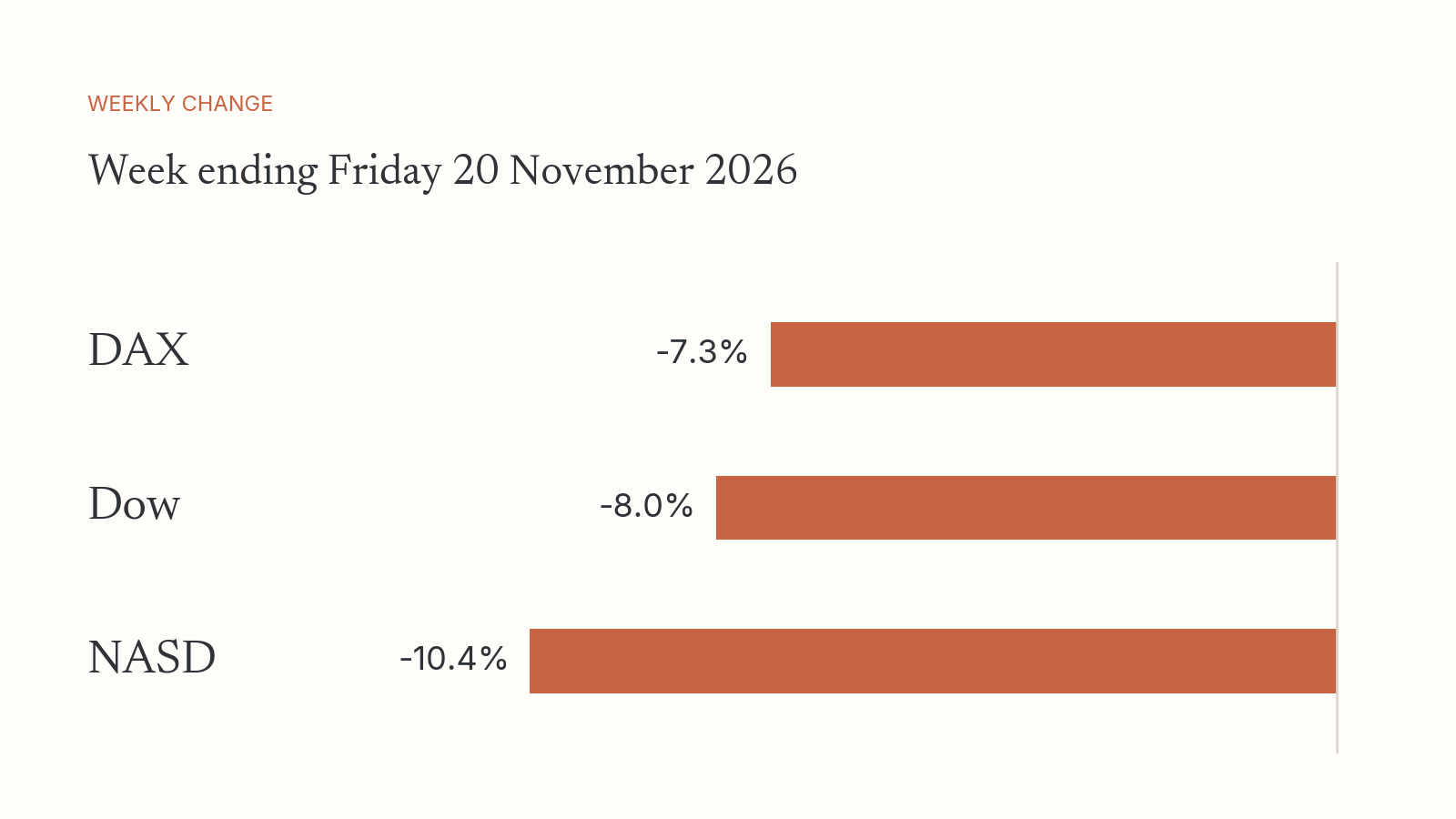
DAX fell 7.3% to 24,802.78, closing Friday right on its low of the week and only six sessions after setting a fresh all-time high, so the whole of the November rally has now been given back and then some. Dow lost 8.0% to 48,147.33, falling every day of the week and finishing about 12% below its record, which puts it firmly in what traders call a correction. NASD (the Nasdaq-100) took the worst of it, down 10.4% to 25,028.98, with 5.6% of that coming on Friday alone. Chip stocks had their worst week since 2001, and Nvidia’s slide has been made heavier by the sudden resignation of its chief executive, Jensen Huang, the week before, along with a reported SEC inquiry into the company’s disclosures.
NASD’s Friday close is more than 20% below its record of 31,404.65 from earlier in the year, and a fall of 20% is the usual line people draw for a bear market. That’s a label, not a signal, and it doesn’t tell you what happens next, but it does show how far and how fast the AI trade has unwound since early October.
The week ahead
This is a short week in the US, with markets closed on Thursday for Thanksgiving and closing early on Friday. Holiday weeks tend to see fewer people trading, and thinner markets can move further than usual on little news, so after a week like the last one it makes sense to look again at your position sizing before you place anything.
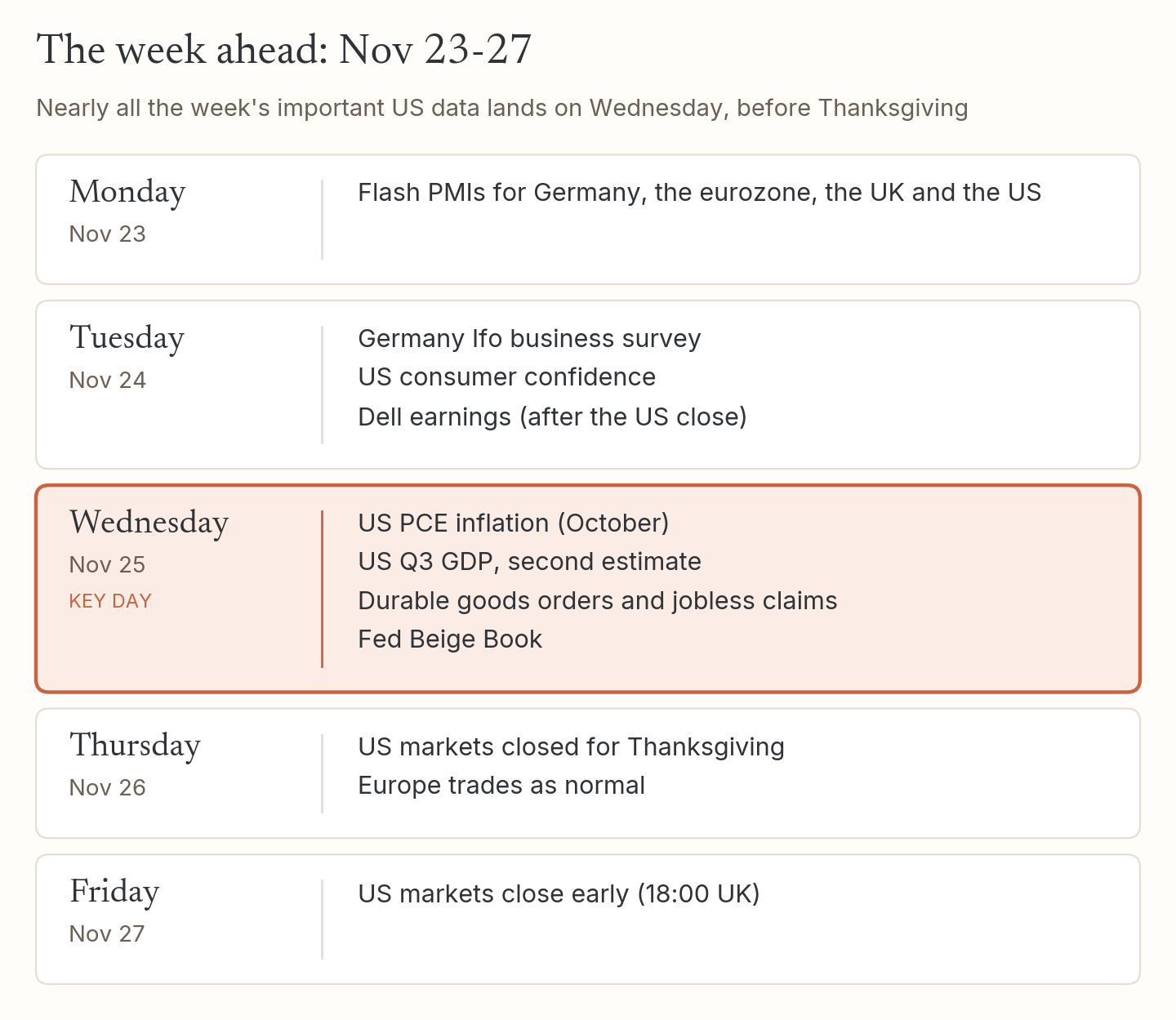
Because of the holiday, the week’s important US releases have been pulled forward and almost all of them arrive on Wednesday. Monday brings the flash PMI surveys for Germany, the eurozone, the UK and the US, the first look at how business activity held up in November. Tuesday has Germany’s Ifo business survey, US consumer confidence, which gives a sense of how people feel heading into the holiday shopping season, and Dell’s results after the US close. Wednesday is the key day, with October’s PCE inflation figures, the second estimate of third-quarter US growth, durable goods orders and the weekly jobless claims all due together at 13:30 UK time, followed later by the Fed’s Beige Book, a round-up of business conditions across the country. Thursday is Thanksgiving, so US markets are closed while Europe trades as normal on lighter volume. Friday is a half day in the US, with stocks closing at 18:00 UK time.
DAX
DAX has support around 24,800, where Friday finished and where the index also found buyers twice in early October, with resistance around 25,190, Friday’s high and roughly where the late-October base sat before it broke. Monday’s flash PMI surveys, a monthly poll of purchasing managers that gives an early read on how business is going, are expected to show German activity still growing, and Tuesday’s Ifo survey of German business confidence is forecast to edge up slightly. Good numbers from both would remind people that Europe’s economy isn’t the AI trade, which may help DAX steady itself, though it’s been following Wall Street’s lead closely all week. A close below 24,800 would leave the October shelf behind and suggest the selling has further to go, while getting back above 25,190 would be the first sign of a floor forming.
Dow
Dow has support around 48,000, Friday’s low and a round number that tends to draw attention, with resistance around 49,100, Thursday’s low, which Friday opened beneath and never got back to. Wednesday is the big day, with October’s PCE inflation figures, the measure the Fed watches most closely, landing at the same time as a revised estimate of US growth for the third quarter. PCE is forecast to rise to 3.8% from 3.6%, and as it’s the last inflation reading before the Fed meets on 8 and 9 December, a higher number than expected would strengthen the case for another rise in rates at a time when the market is already struggling, while a softer one could give buyers some breathing room. A close below 48,000 would mean the index has yet to find a floor, while reclaiming 49,100 would suggest the worst of the selling may be easing.
NASD
NASD has support around 24,910, Friday’s low, just under the round 25,000 level, with resistance some way above at about 26,430, Friday’s high and the bottom of the base the index broke through in one day. That gap between the two levels is a good measure of how much ground was lost in a single session. There’s no big AI name reporting this week, and Dell on Tuesday is the closest the calendar gets, so NASD will be taking its lead from Wednesday’s inflation and growth figures and from whether buyers are willing to step back in after Friday. A close below 24,910 would mean a fresh low with nothing obvious underneath, while a move back above 26,430 would undo Friday’s damage and suggest the selling went too far too quickly.
Elsewhere last week
Gold usually holds up when shares are falling, but it fell 9.5% to around $3,515 an ounce as the dollar rose for another week and traders sold what they could to cover losses elsewhere. Brent crude slipped 3.4% to about $92.60 a barrel. EURUSD eased to around 1.097, with the stronger dollar weighing on the euro. Bitcoin fell close to 14% across the week to below $59,000, caught up in the same move away from risk that hit tech shares.
Nothing on this page is financial advice. Levels and views here are a starting point for your own analysis, not a signal to trade.