Managing the Trade
Most of what should happen once a trade is open was already decided before it went live, which means managing a trade well is mostly a discipline problem, following what the plan already said, not a live decision-making problem.
What’s already decided vs what needs a real call
The stop and target come from the plan, and if the strategy calls for moving to breakeven after a defined amount of favourable movement, that’s a rule to apply, not a feeling to wait for. What needs real judgement in the moment is rare: a major, unscheduled piece of news that invalidates the setup’s whole premise, not the ordinary wobble of price moving against an open position the way price always does.
Breakeven and partial exits, done by rule not mood
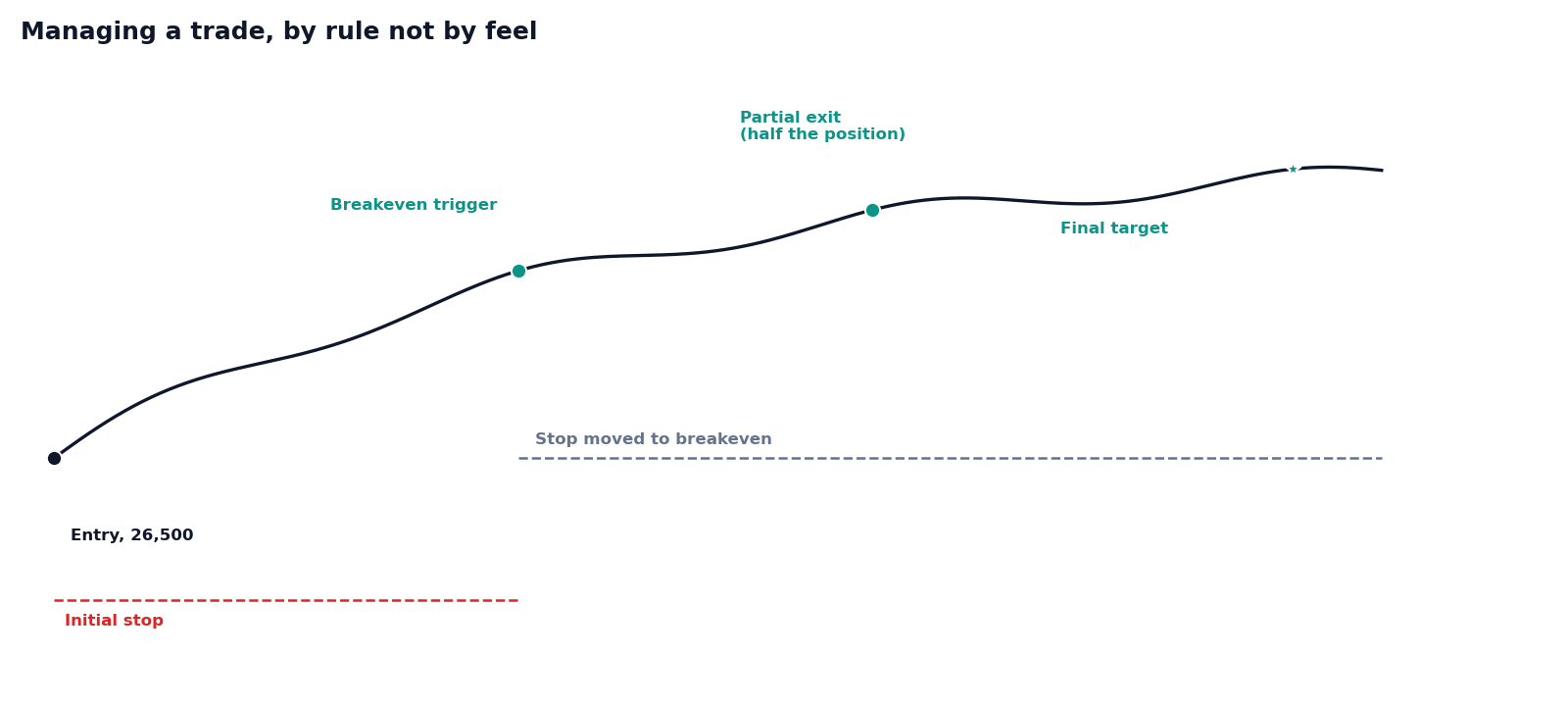
The stop starts below entry, steps up to breakeven once a defined move is reached, part of the position is taken off at an interim target, and the remainder runs to the final target.
A trade managed by rule looks the same regardless of how the trader feels about it that day: the stop moves to breakeven at the same defined point every time, a partial exit is taken at the same kind of level every time, and the remainder runs toward the same kind of target every time. None of those decisions get remade in the moment based on how confident or nervous the position currently feels.
A trailing stop is a different tool from a single breakeven step
Moving a stop to breakeven once and leaving it there suits a trade with a defined target, the risk is removed early and the rest plays out toward a known level. A trailing stop instead, one that keeps following price at a fixed distance or behind each new swing low, suits a trend-following approach with no fixed target, where the goal is staying in a strong move for as long as it keeps extending. Using a single breakeven step on a trend trade can cut a big winner short at its first pullback; using a trailing stop on a defined-target trade adds complexity a simple plan doesn’t need. The choice belongs to the strategy, not to whichever feels more comfortable on a given day.
Scaling in is a different decision from averaging down
Adding to a winning position at a point the plan already specified, once a breakout confirms, say, or once price closes back above a reclaimed level, is a planned decision made in advance, no different in principle from the original entry. Adding to a losing position to improve the average entry price is a fundamentally different thing, closely related to the mistake covered in Revenge Trading: it increases risk on a trade that’s already proving the original idea wrong, in the hope that being wrong for longer eventually becomes being right. The two can look similar on a chart, more size added mid-trade, but one follows a rule decided before the trade existed and the other is a reaction to being down.
Managing more than one open position at once
Two trades on two different instruments aren’t automatically two separate risks if those instruments tend to move together. A long position on GER40 and a long position on a closely correlated European index are, in practice, closer to one larger position on the same underlying bet than two independent 0.5% risks, and a move against that shared theme hits both at once. Checking whether open positions are truly independent, not just nominally different tickers, matters before assuming the account’s total risk is simply the sum of each individual trade’s stated size.
The difference between managing and micromanaging
Checking a position every few minutes and nudging the stop closer “just in case” isn’t management, it’s the same in-the-moment emotional override this course’s Psychology section already covers, just applied to a live trade instead of a standalone decision. A position that’s following the plan doesn’t need constant attention. It needs the plan’s rules applied at the points the plan already defined, and otherwise left alone.
Key takeaways
- The stop and target are decided by the plan; moving to breakeven after a defined move is a rule, not a feeling
- Genuine in-the-moment judgement calls are rare, mostly limited to major unscheduled news that invalidates the setup
- A trailing stop suits a trend trade with no fixed target; a single breakeven step suits a trade with a defined one, the two aren’t interchangeable
- Scaling in at a pre-planned point is a rule; adding to a loser to improve the average price is closer to revenge trading than trade management
- Correlated positions can add up to one larger risk even when they look like separate trades on separate instruments
- Constantly checking and nudging a position is micromanagement, not management, and it’s the same emotional override covered elsewhere in this course
Nothing on this page is financial advice. Trade your own account, manage your own risk.
Nothing on this page is financial advice. Trade your own account, manage your own risk.