Who Controls Markets?
Nobody controls a market the way a hand controls a wheel, but a small number of participants lean on it far harder than everyone else combined, and knowing who they are beats assuming price just wanders around at random.
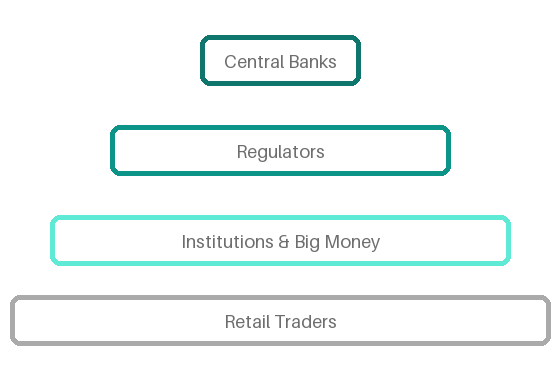
A small number of central banks at the top, down to the many retail traders at the bottom, fewer participants with outsized influence, versus many with individually small influence.
Central banks
Central banks like the Federal Reserve, the ECB, and the Bank of England set interest rates and manage the money supply, and those decisions ripple through every market, not just currencies. A rate hike makes holding cash more attractive relative to riskier assets, which is why indices and growth stocks often fall on hawkish central bank surprises, and a currency tends to strengthen when its central bank is raising rates faster than its peers. This is also why economic calendar events matter more than almost anything else on a trading day.
Regulators
Bodies like the FCA in the UK, the SEC in the US, and ESMA in Europe don’t move price directly, but they set the rules everyone else has to trade within: leverage limits, reporting requirements, what brokers are allowed to offer retail clients. A regulatory change, like ESMA’s leverage caps on retail forex and CFD accounts a few years ago, can reshape how an entire market is accessed without a single trade being placed.
Institutions and big money
Banks, hedge funds, and pension funds move genuinely large size, and because their orders dwarf a retail order, they’re often the actual counterparty on the other side of a retail trade without either side knowing it. A lot of retail trading folklore imagines institutions actively hunting individual traders’ stop losses, but the more accurate picture is that institutions are moving size for their own reasons, and retail stops sitting at obvious levels sometimes get caught in that flow as a side effect, not the target of it.
Where retail traders fit in
Retail trading volume has grown enormously with online access, but it’s still a small fraction of total market volume in most instruments, especially indices and major currency pairs. That’s not a reason to feel powerless: a retail account doesn’t need to move the market to profit from it, it only needs to read what the larger participants are already doing and position alongside that flow rather than against it.
Key takeaways
- No single participant controls a market, but central banks, regulators, and large institutions influence it far more than any individual trader
- Central bank interest rate decisions ripple through currencies, indices, and stocks alike, which is why economic calendar events matter
- Regulators set the rules of access (leverage limits, reporting requirements) rather than moving price directly
- Institutional order flow is large enough that retail traders are often unknowingly on the other side of it
- Retail volume is small relative to the whole market, but that just means the goal is reading the flow, not fighting it
Nothing on this page is financial advice. Trade your own account, manage your own risk.
Nothing on this page is financial advice. Trade your own account, manage your own risk.