Accumulation and Distribution
A market rarely goes straight from one trend into the next. Most of the time it pauses first, spending a stretch going nowhere in particular, and that pause is where the next move gets built. This idea traces back to Richard Wyckoff, an early twentieth-century trader who framed the market as cycling through four phases, and the two ranging phases, accumulation and distribution, are the ones to learn to spot while they’re happening, not only after the fact.
The four-phase cycle
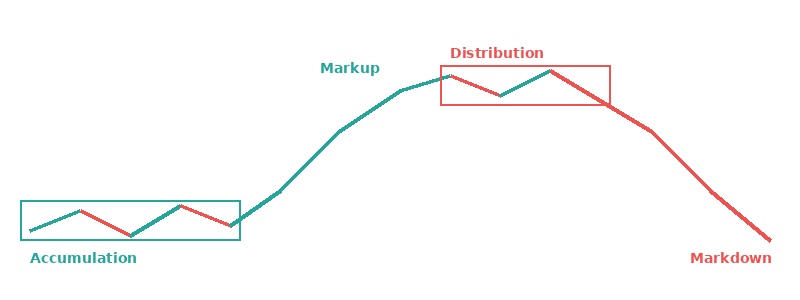
Accumulation at the bottom of a range, markup as it breaks higher, distribution at the top, markdown as it breaks lower.
Accumulation is a range that forms after a decline, price going sideways rather than continuing to fall, while larger participants build a position without pushing the price away from itself in the process. Markup is what follows once that buying pressure finally tips the balance, the range resolves upward, and the trend everyone associates with a “market going up” begins.
Distribution is the same idea inverted, sitting at the top of a rally instead of the bottom, a range where the position built during the uptrend gets offloaded gradually, not dumped all at once. Markdown is the decline that follows once selling finally overwhelms what demand is left. Then the cycle repeats, markdown eventually slowing back into another accumulation range.
Calling it while it’s still happening
Every range looks like it could be either phase while it’s still forming, and the label that applies is only confirmed once the range resolves. A range that breaks up and holds was accumulation. The same-looking range that breaks down and holds was really just a pause inside a bigger downtrend, sometimes called re-distribution instead of accumulation. Calling a range “accumulation” purely because it’s sitting near recent lows, before it’s broken out, is more hope than analysis.
What helps is watching for the same break of structure that confirms any trend change, a clean break out of the range, holding on the retest, rather than trying to guess the phase from the shape of the range alone.
Why the framing is still useful
Even with that limitation, thinking in terms of accumulation and distribution changes how you read a range while you’re in it. Instead of treating sideways price as dead time to ignore, it’s the stage where the next move is being prepared, and the eventual break out of it, in either direction, carries more weight for having come out of an extended period of two-sided trade instead of a sharp V-shaped turn with no base behind it.
Key takeaways
- Wyckoff’s cycle: accumulation, markup, distribution, markdown, then back to accumulation
- Accumulation is a base built after a decline; distribution is the mirror image built after a rally
- Neither phase can be confirmed with certainty until the range resolves and holds on the retest
- A break out of a well-formed range tends to carry more weight than a sharp move with no base behind it
- Watch ranges as preparation, not dead time, but confirm the phase with the breakout, not the shape
Nothing on this page is financial advice. Trade your own account, manage your own risk.
Nothing on this page is financial advice. Trade your own account, manage your own risk.