Liquidity and Stop Hunts
Every stop-loss order sitting in the market is also, from a different angle, a resting order waiting to be filled, and clusters of those resting orders are what “liquidity” means in this context. Understanding where that liquidity sits, and why price so often seems to go find it right before turning, changes how you read the approach to an obvious level.
Where liquidity collects
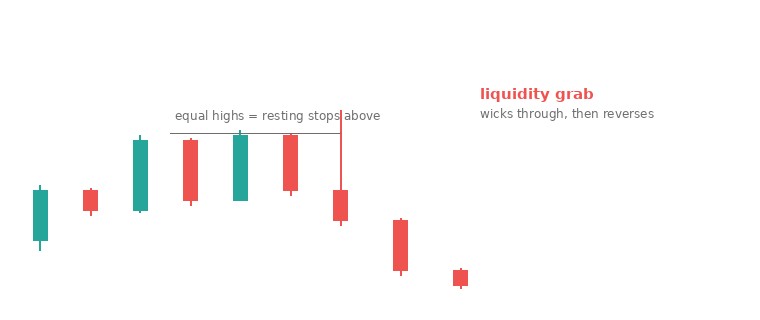
Equal highs draw resting stops just above them. Price wicks through to run them, then reverses.
Liquidity pools above recent swing highs and below recent swing lows, since that’s where traders holding the opposite position have their stops parked, and it pools especially heavily wherever two or more highs (or lows) sit at roughly the same level, because that shared level is the most obvious place on the chart for a stop to be placed. Round numbers draw the same kind of cluster, for the same reason, they’re an obvious, memorable place to set a level.
Why price gets drawn there
Large orders need the other side of the trade filled, and running through a cluster of stops is one of the more efficient ways to find that liquidity, each stop that triggers becomes a market order on the other side of the book. Whether that’s a precise description of the mechanism or a simplified model for something messier under the hood is hard to say with certainty, but the pattern, price pushing just beyond an obvious level before reversing, shows up often enough to plan around.
Telling a hunt from a real breakout
A genuine breakout holds. Price clears the level, closes beyond it, and follows through, giving you the break of structure that confirms the new direction. A stop hunt does the opposite: price wicks through the level, sometimes only barely, sometimes by a meaningful margin, and then snaps back the other way, often leaving a long rejection wick as the only evidence anything happened there at all. The wick is doing the work in a hunt. The close is doing the work in a real break.
What this changes about your own stops
Placing a stop right at the obvious level, the same swing high or low everyone else can see, puts it right inside the zone most likely to get run before the real move happens. Giving it a bit of room beyond the level, enough to sit outside the immediate liquidity pool, reduces the odds of getting caught in a hunt that reverses in your favour a few candles later. Some traders go further and use the hunt-and-reverse pattern itself as an entry signal, waiting for the wick-and-rejection at an obvious level instead of just avoiding it.
Key takeaways
- Liquidity pools above recent swing highs and below recent swing lows, especially where multiple highs or lows line up
- Big orders need an opposite side to fill against, and running stops is one way that liquidity gets found
- A real breakout closes beyond the level and follows through; a stop hunt wicks through and reverses
- Placing your own stop with some room beyond the obvious level avoids sitting inside the pool most likely to get run
- The hunt-and-reverse pattern itself can be read as an entry signal rather than something to only defend against
Nothing on this page is financial advice. Trade your own account, manage your own risk.
Nothing on this page is financial advice. Trade your own account, manage your own risk.