Order Blocks
An order block is the last candle standing against a strong move, right before that move takes off, and the interesting part is what it implies about why price so often comes back to visit it.
What counts as an order block
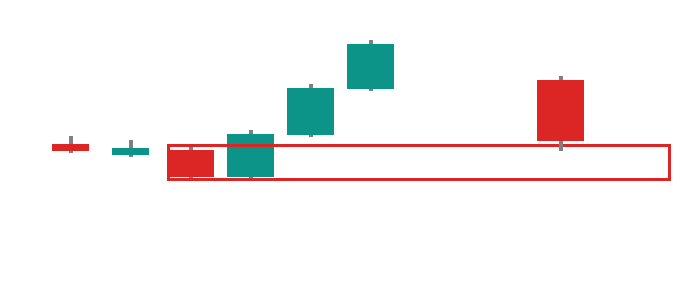
The last down candle before an impulsive rally, marked as a zone. Price returns to test it later.
A bullish order block is the last down candle (or last down-closing candle) before a sharp, sustained move higher, while a bearish order block is the same idea flipped, the last up candle before a sharp move lower. “Opposing” just means moving against the direction of whatever shows up right after it.
Example: three quiet, narrow-range candles, then one that closes down, then four strong candles up in a row without much pullback, and that down candle is the order block for the move that follows.
Why price returns to test it
The common explanation is that the candle marks a spot where orders were left unfilled: buyers who wanted in got skipped over as the market moved away too quickly, and price eventually drifts back to let them fill. Whether that’s a precise description of what’s happening under the hood, or just a decent enough model for something more complicated, is hard to say with certainty. What’s easier to say is that the zone tends to get revisited often enough to earn a mark on the chart.
Marking the zone
Some people mark only the body of the candle, others the full range including the wick. I’d rather use the full range: it’s a wider net, and it means you’re not missing a valid reaction just because price wicked slightly past the body before turning.
Order blocks and fair value gaps together
An order block sitting on its own is a zone to watch, but an order block that lines up with a fair value gap is a zone to trade, because the same area is being flagged by two separate pieces of evidence. This is the same confluence idea that shows up throughout this section: no single tool is the edge, the overlap between tools is.
Key takeaways
- An order block is the last candle against the move, right before the move happens
- Bullish order block = last down candle before a strong rally; bearish = last up candle before a strong decline
- Mark the full candle range, not just the body, so you don’t miss a valid reaction at the wick
- Whether the “unfilled orders” explanation is literally true or just a useful model, the zone still tends to get revisited
- An order block plus a fair value gap in the same area is worth more than either alone
Nothing on this page is financial advice. Trade your own account, manage your own risk.
Nothing on this page is financial advice. Trade your own account, manage your own risk.