Breakouts and Fakeouts
Price pokes above resistance, the candle looks decisive, and half the traders watching jump in on the break, only for price to reverse hard and leave them holding a loss inside the old range. The other half wait, watch the retest hold, and get a cleaner entry a few candles later. The difference between the two groups usually comes down to patience, not analysis.
What a breakout is supposed to do
A genuine breakout clears a level, support or resistance, and keeps going with enough conviction that the level stops mattering as a ceiling or floor. The clearest tell isn’t the initial break candle, it’s what happens in the few candles after, does price hold above the old resistance, or does it drift straight back below it as if the break never happened.
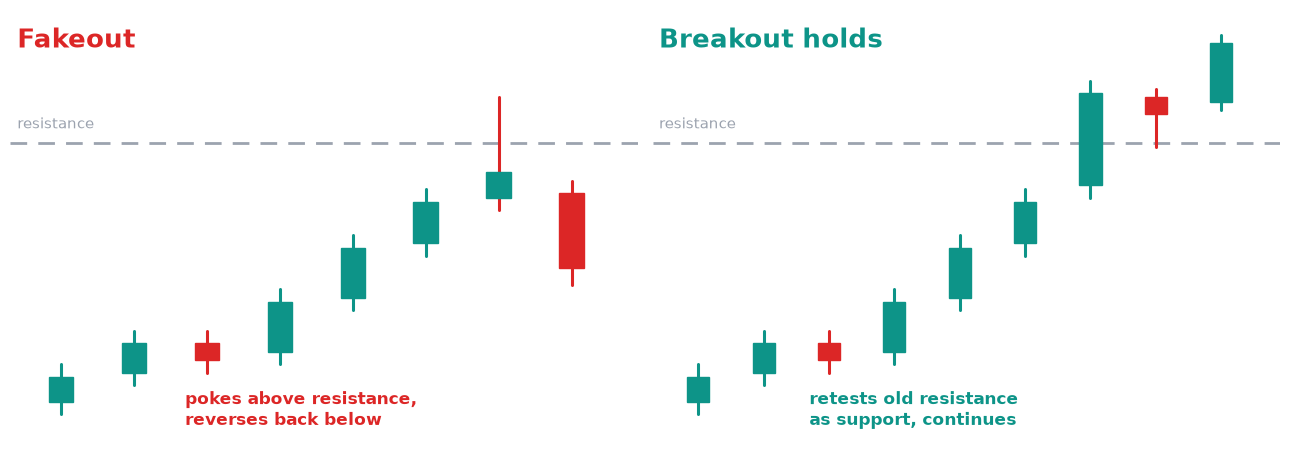
A fakeout pokes through and reverses. A held breakout retests the old level as support before continuing.
The retest is the real signal
The most reliable version of a breakout isn’t the initial break candle at all, it’s the pullback afterward that tests the old resistance as new support and holds there. That retest holding is stronger evidence than the original break, because it shows the level has changed sides rather than just being pierced once on momentum. Waiting for it costs some of the move, but it filters out a large share of the breakouts that were never going to hold in the first place.
Example: DAX breaks above a resistance zone that’s held for a week, pulls back to retest it two candles later, and that retest holding is usually the safer entry compared to chasing the original break candle.
Why fakeouts happen so often
Levels that are obvious to you are obvious to everyone else watching the same chart, which is why they attract stop orders clustered just beyond them. A move that pokes through, triggers those stops, and then reverses once the liquidity’s been taken is a common enough pattern that it has its own name, a stop hunt, and it’s one of the main reasons breakouts fail as often as they do. The volume behind the initial poke often looks impressive precisely because it’s stop orders firing, not fresh conviction entering the market.
Reading volume and follow-through
A breakout on noticeably higher volume than the preceding range carries more weight than one on thin volume, since real conviction tends to show up as real participation. Follow-through matters just as much, one strong break candle followed by two or three candles that keep making progress in the same direction says something a single spike candle can’t. A break candle that immediately gets matched by an equally large candle back the other way is behaving like a fakeout regardless of how strong that first candle looked.
Key takeaways
- A breakout only means something if price holds beyond the level in the candles that follow, not just on the break candle itself
- The retest of the old level as new support (or resistance) is often a stronger, safer signal than the original break
- Fakeouts happen because obvious levels attract stop orders, and a poke through to trigger them looks like momentum but often isn’t
- Higher volume on the break candle, plus genuine follow-through afterward, both add confidence
- A break candle instantly reversed by an equally strong candle the other way is a fakeout, no matter how convincing it looked at first
Nothing on this page is financial advice. Trade your own account, manage your own risk.
Nothing on this page is financial advice. Trade your own account, manage your own risk.