Inside Bars and Compression
A market that’s coiling gives off a specific look before it moves, each swing a little smaller than the last, as if the energy behind the price is running out of room in both directions at once. Traders who learn to spot that shrinking range early get to position before the release, instead of chasing it after the fact.
What an inside bar is
An inside bar is a candle whose entire range, high to low, sits inside the range of the candle before it. One inside bar on its own doesn’t say much, it happens constantly and most of the time it’s just noise. A run of two or three in a row, each one tighter than the last, is the more useful pattern, showing the range contracting instead of one quiet candle sitting in an otherwise normal sequence.
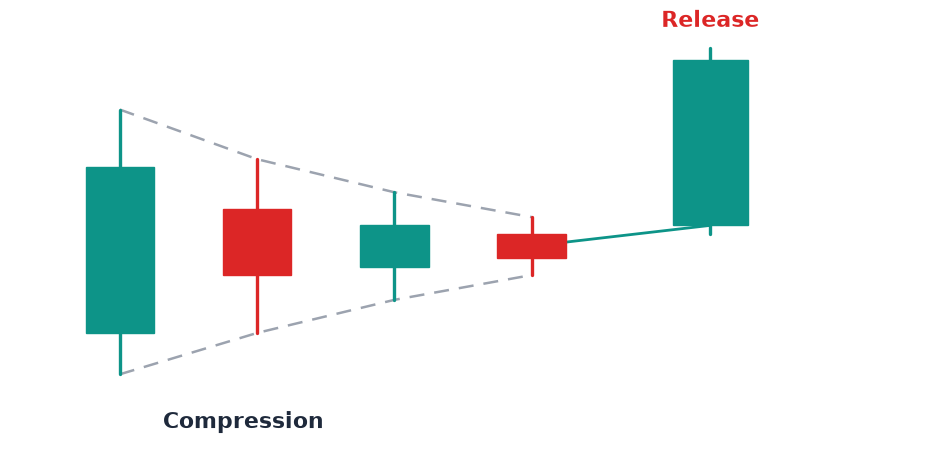
A wide mother bar, three inside bars each nested inside the last (IB1, IB2, IB3), then a decisive break out of the compression.
Example: GER40 prints a wide-range hourly candle, the mother bar, then three inside bars in a row during a quiet Asian session, IB1, IB2, and IB3, each one’s high and low sitting inside the one before it. A strong London-open candle then breaks clean above the mother bar’s high and keeps going, and that open is usually a cleaner signal than trying to anticipate the direction beforehand.
Compression as a bigger-picture pattern
Zoom out from individual inside bars and the same idea shows up across whole swing sequences, a series of highs and lows converging toward each other, drawing something close to a triangle on the chart. The market is running out of room to keep testing both sides of the same range, and that squeeze tends to resolve with more force than the slow grind that built it, because the orders that would normally have triggered along the way are still sitting there, waiting for the range to finally give.
Trading the release
The break out of a compression pattern is what most traders are positioning for, not the compression itself. The safest version waits for a candle to close clearly outside the narrowing range, ideally on a pickup in volume, instead of guessing which direction the squeeze resolves before it does. Guessing the direction of a compression pattern before it breaks is a coin flip dressed up as analysis, the compression itself rarely tells you which way it’ll go, only that a move is coming.
Where compression shows up most
Tight ranges before a session open are one of the most reliable places to see this pattern, since liquidity thins out overnight and price naturally drifts into a narrower band until the next session brings volume back. The same pattern shows up ahead of major news releases too, where the market compresses while waiting for the data, then releases hard once the number prints. Either context is a reasonable place to watch for the pattern, but neither one guarantees which direction the eventual break favours.
Key takeaways
- One inside bar alone means little, a run of two or three shrinking bars in a row is the more useful signal
- Compression also shows up across whole swing sequences, highs and lows converging toward a point before a break
- Wait for a clear close outside the range, ideally with a volume pickup, rather than guessing the breakout direction in advance
- Pre-session and pre-news compression are common settings for this pattern, though neither tells you which way it breaks
- The squeeze itself only signals that a move is coming, not which direction it favours
Nothing on this page is financial advice. Trade your own account, manage your own risk.
Nothing on this page is financial advice. Trade your own account, manage your own risk.