Pullbacks and Entries
Chasing the first strong candle of a move feels like the obvious thing to do, and it’s usually the wrong one. The traders who wait for price to pull back first tend to get a better price, a clearer stop level, and confirmation that the move has real support behind it, all from doing less rather than more.
Why the pullback is the better entry
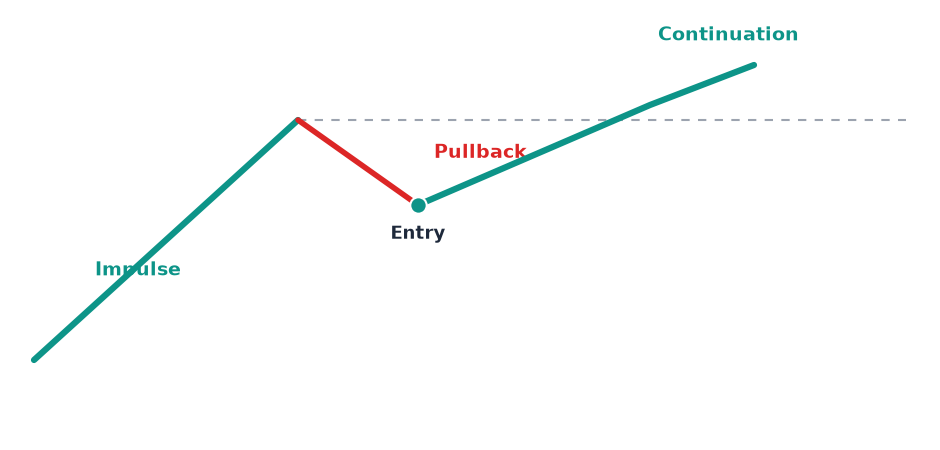
An impulsive leg, a pullback that doesn’t erase it, and a continuation from a much better price than chasing the impulse would have offered.
An impulsive move, the first sharp leg in a new direction, tells you something changed, but it also tends to move price too far, too fast for a comfortable entry with a tight stop. The pullback that follows gives back some of that move without erasing the shift that caused it, and buying or selling into that pullback gets you in closer to the level that mattered in the first place, with a much clearer point to place a stop below or above.
What makes a pullback different from a reversal
The distinction that matters here is depth and structure, not just direction. A healthy pullback usually retraces a portion of the impulsive leg, often somewhere in the 38% to 61% range measured with a Fibonacci tool, and holds a higher low (in an uptrend) before continuing. A pullback that erases the entire impulsive leg and pushes into new territory the other way has stopped being a pullback, that’s a reversal wearing a pullback’s clothes, and treating it as a buying opportunity is how a lot of pullback trades turn into full losses.
Example: Nasdaq rallies sharply off a session low, pulls back roughly half that move, holds above the prior swing low, and resumes higher, that’s a textbook pullback entry, not a reversal.
Confirming the pullback is done
Waiting for some sign that the pullback has finished, instead of guessing the exact low or high, avoids a lot of premature entries. A common approach is watching for the pullback’s own smaller structure to break, a short-term downtrend inside the pullback finally printing a higher high, which suggests the larger move is ready to resume. This costs a little of the move compared to guessing the exact turning point, but it avoids catching a pullback that’s still deepening.
When there’s no pullback to wait for
Some of the strongest moves never give a clean pullback at all, price just runs, and traders waiting for an entry that never comes miss the trade completely. There’s no clean fix for this, chasing a move that never pulls back carries real risk, and missing a move that never pulls back costs nothing but opportunity. Most traders accept missing some of these instead of abandoning the discipline of waiting for structure, because the pullback method’s edge comes from the patience itself, not from catching every single move.
Key takeaways
- A pullback entry usually beats chasing the impulsive leg, offering a better price and a clearer stop level
- Healthy pullbacks typically retrace 38% to 61% of the impulsive move and hold a higher low (or lower high) before continuing
- A pullback that erases the entire impulsive leg has become a reversal, not a pullback, and shouldn’t be traded as one
- Confirm the pullback is finished by watching its own smaller structure break, instead of guessing the exact turning point
- Some strong moves never pull back at all, missing those is the accepted cost of trading the pullback method with discipline
Nothing on this page is financial advice. Trade your own account, manage your own risk.
Nothing on this page is financial advice. Trade your own account, manage your own risk.