Candlestick Basics
Before any pattern makes sense, a single candle has to make sense, because every pattern is really just a handful of these stacked next to each other and read as a group.
Four numbers, one shape
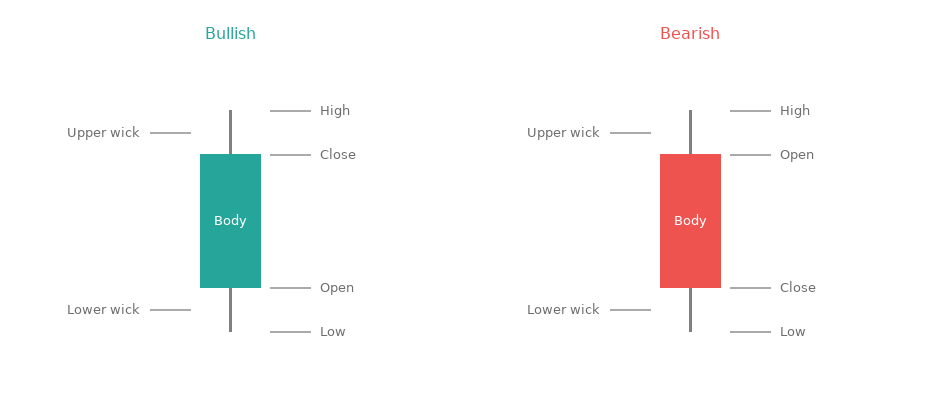
Same four numbers, two outcomes. Teal closes above open, red closes below it.
Each candle covers one fixed slice of time, a minute, an hour, a day, whatever the chart is set to, and it’s built from four prices: the open and close, which set the top and bottom of the solid body, and the high and low, which set the thin wicks above and below it. If the close finishes above the open, the body is teal on this site’s charts; if it finishes below, it’s red. The colour is just a shortcut for which of those two numbers won.
Body versus wick
The body tells you where the candle settled, and the wicks tell you where it wandered off to without staying. A long body means one side was in control for the whole period, closing near one extreme with hardly any argument along the way. A long wick with a small body tells a different story: price pushed hard in one direction and got shoved straight back, so the level it reached was tried and rejected rather than accepted.
Example: a candle opens at 1.0850, spikes down to 1.0820 to sweep some stops, then closes back at 1.0855. The body is tiny and sits near the top, and the long lower wick is the part worth watching, price tried lower and got rejected almost immediately.
Reading a run of candles
One candle is a snapshot; a few in a row start telling a story. A string of teal candles with small wicks and rising closes says buyers stayed comfortably in charge the whole way. The same string with a bearish candle ploughing through it and closing near its low says something changed, and that’s usually the point on the chart worth paying attention to, not the calm stretch before it.
Key takeaways
- A candle is built from four prices: open and close (the body), high and low (the wicks)
- Body colour just marks which of open/close was higher; this site uses teal for bullish and red for bearish
- A long body with small wicks means one side stayed in control the whole period
- A long wick with a small body means a level was reached and rejected, not accepted
- Read candles in groups, not isolation, that’s where patterns and shifts in control show up
Nothing on this page is financial advice. Trade your own account, manage your own risk.
Nothing on this page is financial advice. Trade your own account, manage your own risk.