Support and Resistance
Support and resistance are simply the levels where price has reacted before, on the working assumption that where the market cared once, it’s likely to care again. It isn’t a law, but it’s a strong enough tendency to build a plan around.
What a level is
Resistance sits above current price, where sellers previously showed up in enough size to turn the market back down, while support sits below, where buyers did the same thing on the way back up. Neither is really a single price so much as a zone, bounded roughly by the wicks that tested it and the closes that respected it. Ask the market to bounce off an exact line to the pip and you’re asking for more precision than it usually offers.
Example: GER40 wicks into 18300 three separate sessions and closes back below it each time, and that’s resistance, even though the exact wick high differs by a few points on each visit.
The flip: old resistance becomes new support
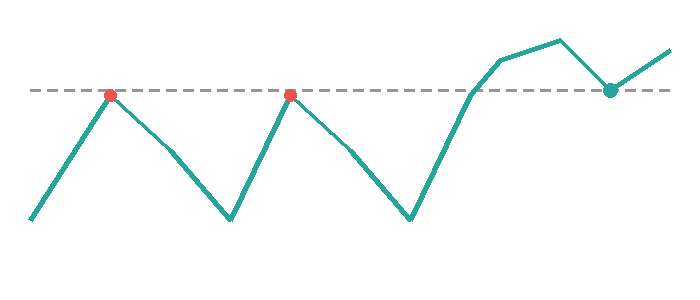
Two rejections at resistance, then a break through, then a retest that holds. The same level, now acting as support.
Watch a level long enough and you’ll see this happen: once it breaks and price closes beyond it with some conviction, that old resistance often turns into new support on the way back down to test it. The level itself hasn’t moved so much as which side now holds it.
Example: EURUSD grinds under 1.0850 for a week, finally closes above it on a strong session, then dips back down to 1.0850 and holds, and that dip is the retest, usually a cleaner entry than chasing the original breakout.
Levels get used up, or they don’t
More touches on a level can mean two opposite things, and that’s the part to think through carefully. It can mean the level is well defended, tested and holding each time, or it can mean the level is running out of orders to absorb and the next test is the one that finally breaks it. Counting touches alone won’t tell you which. What matters more is how price behaves on the approach, whether it’s slowing down and showing rejection or arriving with momentum and barely pausing. The same “look for a setup” logic from Candlestick Patterns and Fair Value Gaps applies here too.
Confluence
A support or resistance level on its own deserves a mark, but the same level lining up with a session open, an order block, or a fair value gap earns a good deal more attention, because several separate reasons for the market to react in the same place tend to carry more weight than any one of them alone.
Key takeaways
- Support and resistance are zones, not exact lines. Think in terms of a range, not a single price
- Old resistance often becomes new support (and vice versa) once a level breaks with conviction
- More touches on a level can mean it’s well defended or running low on orders. You can’t tell which from touch count alone
- Watch how price behaves on approach, not just whether it’s approaching
- A level lining up with a session open, order block, or FVG carries more weight than the level alone
Nothing on this page is financial advice. Trade your own account, manage your own risk.
Nothing on this page is financial advice. Trade your own account, manage your own risk.