Volume
Price tells you what happened; volume tells you how much conviction was standing behind it, and read together they say a great deal more than either one alone.
Volume as conviction
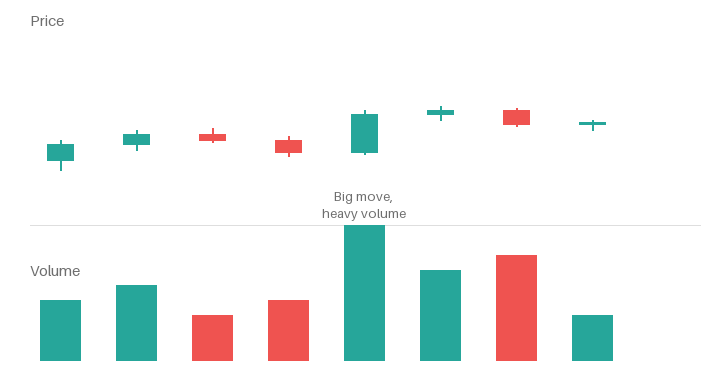
A price move accompanied by a clear jump in volume, then a fade back toward normal on the smaller candles that follow.
A big price move on heavy volume means a lot of participation went into it, which tends to carry more weight than the same-sized move on light volume, where a handful of orders could have pushed price around with nobody else really involved. A breakout through a key level on rising volume looks like genuine interest joining the move, while the same breakout on falling or unremarkable volume looks thin, more like price drifted through the level than broke it with any conviction behind it.
Example: price breaks above a resistance level with volume roughly double the recent average, and the next few candles keep closing higher. A near-identical break the week before happened on below-average volume and fully reversed within the hour. Same chart pattern, very different amount of participation behind each one.
The limit on CFD and forex charts
Volume shown on most CFD and forex platforms isn’t the total volume traded across every market, because forex in particular has no single central exchange to measure that from. What’s displayed is usually tick volume, a count of price changes rather than actual transaction size, or your specific broker’s own volume, a slice of the whole market rather than the whole thing. It’s still a genuinely useful proxy for relative activity on your own chart, just not the literal number of contracts changing hands the way exchange-traded volume would be.
Using it well
Volume works best as confirmation alongside a level or a pattern, not as a standalone signal on its own. Rising volume into a breakout, a reversal candle, or a retest adds weight to what price is already suggesting, while a big move on unusually low volume is a reason to treat it with more caution, since it hints that few people were behind it.
Key takeaways
- Volume measures conviction: the same price move carries more weight on high volume than low volume
- A breakout on rising volume suggests genuine participation; the same breakout on weak volume looks thin
- CFD and forex volume is typically tick volume or broker-specific volume, a useful proxy for activity, not literal market-wide volume
- Use volume to confirm what a level or pattern is already suggesting, not as a signal by itself
- A big move on unusually low volume is a reason for extra caution, not less
Nothing on this page is financial advice. Trade your own account, manage your own risk.
Nothing on this page is financial advice. Trade your own account, manage your own risk.