Compounding
A trader who makes a modest, consistent return every month, and never blows up the account in between, ends up ahead of a trader chasing bigger swings who occasionally wipes out a chunk of it, even when that second trader’s best months looked more exciting along the way.
Compounding rewards consistency over size
Gains compound on whatever the account currently holds, so a smaller return sustained over many periods outgrows a larger return that gets interrupted by one big loss. The big loss doesn’t just erase that period’s gain, it erases the base the next gain would have compounded on.
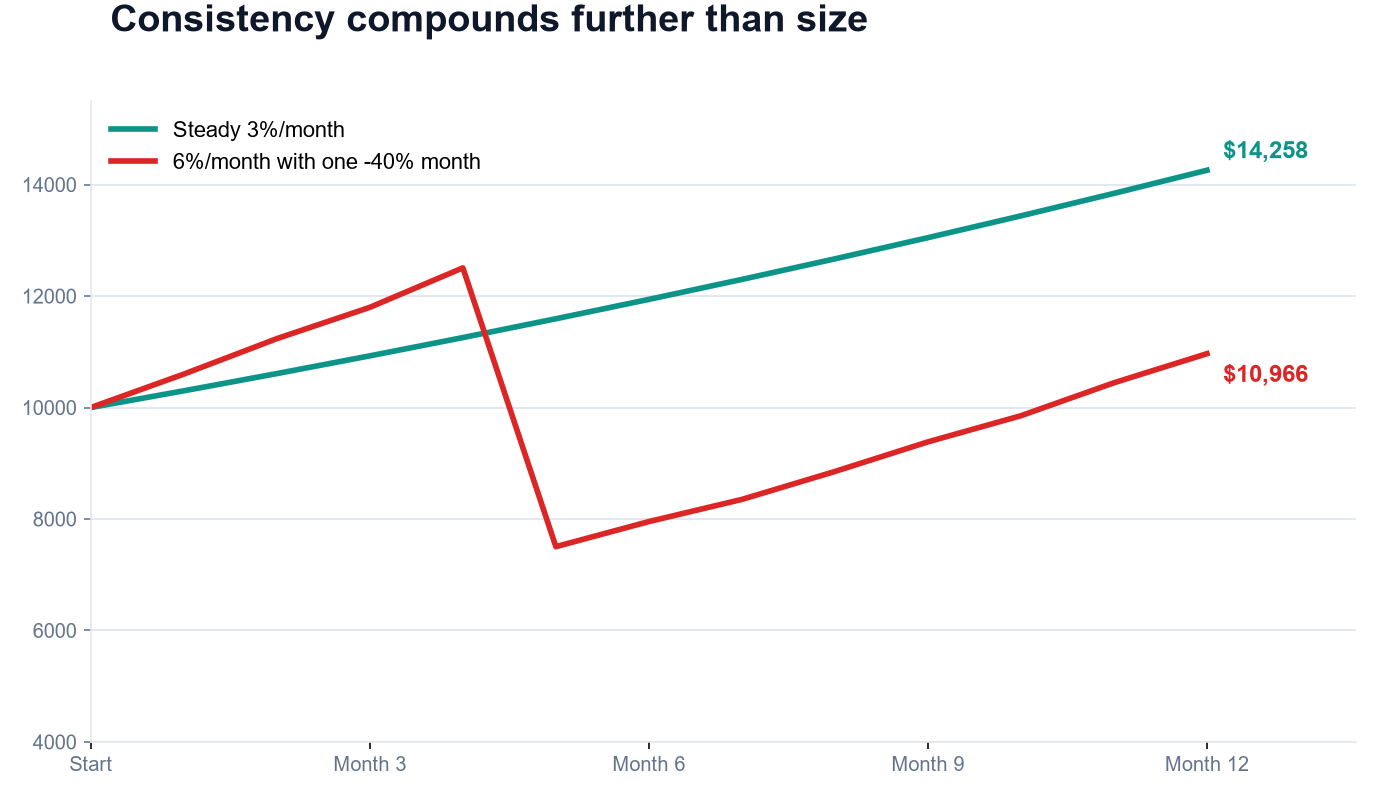
A steady 3% a month finishes higher over a year than a mix of bigger gains broken up by one bad month, even though the second account’s average monthly return looks better on paper.
Example: two $10,000 accounts over 12 months. One returns a steady 3% a month, compounding to roughly $14,258. The other returns 6% most months but has one -40% month somewhere in the run, and finishes lower despite the higher average, because that one month didn’t just cost 40% of that month’s balance, it cost 40% of everything compounded up to that point.
Why a blown account resets more than the balance
Losing back to zero, or close to it, doesn’t just cost the money, it costs every period of compounding that already happened, because the next gain compounds on whatever’s left rather than on what used to be there. Recovering to the old peak takes disproportionately longer than it took to lose it, the same asymmetry covered in Account Management, and restarting the compounding clock from a much smaller base is the real cost of a blow-up, not just the number lost.
What breaks compounding in practice
Compounding maths looks clean on a spreadsheet and gets broken by the same things covered elsewhere in this section: oversized positions relative to account risk, moving stops instead of respecting them, and drawdowns that aren’t caught early. Compounding isn’t a separate skill from risk management, it’s what risk management done consistently produces over enough time, and it’s the reason a boring, repeatable process tends to outperform a more exciting one with occasional big setbacks.
Key takeaways
- A smaller return sustained without interruption compounds to more than a bigger return with an occasional large loss
- A big loss doesn’t just cost that period’s gain, it costs the base every future gain would have compounded on
- Recovering from a blown or near-blown account takes disproportionately longer than it took to lose it
- Compounding is the long-run result of applying risk management consistently, not a separate skill on top of it
Nothing on this page is financial advice. Trade your own account, manage your own risk.
Nothing on this page is financial advice. Trade your own account, manage your own risk.