Position Sizing
Position size decides how much a single trade can cost, and it’s the one number in a trading plan that shouldn’t be guessed at or picked out of habit. It’s an output of two other numbers, not a decision made on its own.
The formula
Position size = risk amount ÷ stop distance. Decide how much money the trade is allowed to lose, decide how far away the stop needs to sit based on the chart, and the size that connects the two is arithmetic, not a feel.
Example: a $10,000 account risking 1% per trade has $100 at risk. On a US500 CFD where each point is worth $1 per lot, a stop 20 points away needs a position of $100 ÷ 20 = 5 lots. If the stop is hit, the loss is 20 points × $5 a point, exactly the $100 that was budgeted.
Why lot size can’t come first
The common backwards version of this looks like a trader who always runs 1 lot, or always runs 0.5 lots, out of habit, then places whatever stop looks reasonable on the chart afterward. That order means the actual dollar risk swings wildly from trade to trade depending on where the stop happens to land, without anyone deciding that on purpose. The stop belongs where the trade idea is proven wrong (see Stop Loss Placement), and the size gets built around that distance, never the other way round.
Example: two GER40 setups in the same week, one with an 80-point stop beyond a swing low, one with a 25-point stop under a tight consolidation. A trader running a flat 2 lots on both risks more than three times as much on the wider setup without ever choosing to.
Same risk, different size
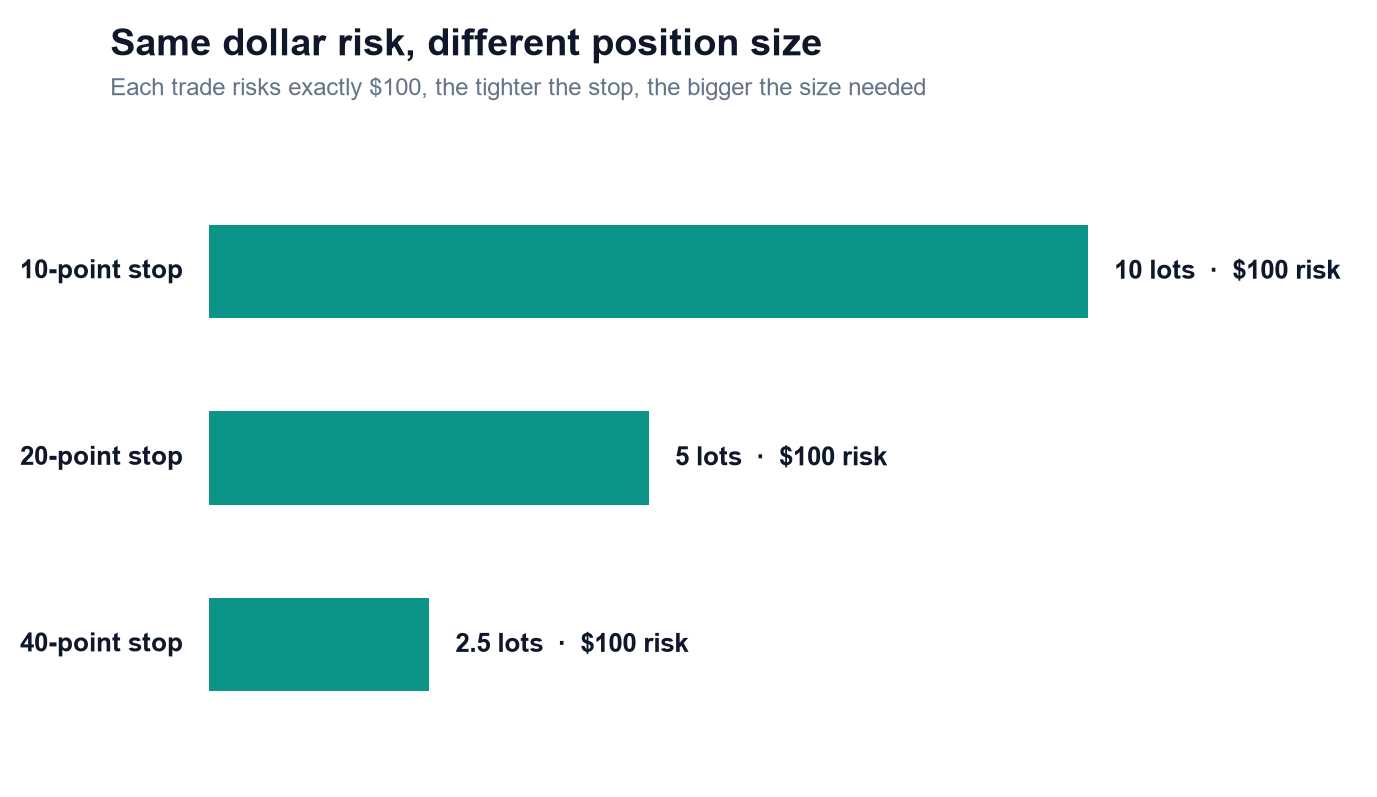
All three trades risk the same $100. The tighter the stop, the bigger the position needed to reach that number, and the wider the stop, the smaller.
A wider stop isn’t automatically a bigger risk if the size gets scaled down to match it, and a tighter stop isn’t automatically safer just because the size looks smaller in lots. What controls risk is the dollar amount at stake, and that figure should stay roughly constant trade to trade even as stop distances move around with the chart.
Keeping the risk percentage steady through a losing streak
Sizing off a fixed percentage of current equity means position size shrinks a little after losses and grows a little after gains, automatically, without anyone needing to step in and adjust it. Sizing off a fixed dollar amount or a fixed lot count instead means a losing streak keeps risking the same figure against a shrinking account, so the real percentage risked per trade quietly climbs the deeper the drawdown goes, right when it should be doing the opposite.
Key takeaways
- Risk amount and stop distance are the inputs, position size is the output that connects them
- Never pick a lot size first and then find a stop that “looks right” for it
- A wider stop with a smaller size and a tighter stop with a bigger size can carry identical risk
- Size off a fixed percentage of current equity, not a fixed lot count, so risk shrinks automatically through a losing streak instead of climbing
Nothing on this page is financial advice. Trade your own account, manage your own risk.
Nothing on this page is financial advice. Trade your own account, manage your own risk.