Impulse and Corrective Waves

Not every leg on a chart is doing the same job. Some moves are the trend actually going somewhere, and others are just the market working off the last move before it can continue, and learning to tell the two apart on sight is most of what’s needed before wave counting starts to make sense. What an impulse wave looks like An impulse wave is the trend doing its real work, price covering ground quickly and directly, with candles that mostly close in the same direction and don’t overlap each other’s ranges very much. It’s the kind of move that leaves large fair value gaps behind, because it’s outrunning the two-sided trade that would otherwise fill in every level along the way. If you had to describe it in one word, it would be committed. ...
3 min · Clear Head Trading

Pullbacks and Entries

Chasing the first strong candle of a move feels like the obvious thing to do, and it’s usually the wrong one. The traders who wait for price to pull back first tend to get a better price, a clearer stop level, and confirmation that the move has real support behind it, all from doing less rather than more. Why the pullback is the better entry An impulsive leg, a pullback that doesn’t erase it, and a continuation from a much better price than chasing the impulse would have offered. ...

3 min · Clear Head Trading

Trendlines

A trendline is just a line connecting two or more swing points, but drawn carelessly it can be made to say almost anything, which is exactly why so many of them turn out to mean nothing at all. Wicks or bodies as the anchor A downtrend line connects a series of falling swing highs, the same way an uptrend line connects rising swing lows, but a single line through two points isn’t proof of anything yet, it only starts to mean something once price returns to it and reacts a third time. Two points can always be joined; a third touch that holds is what suggests other traders are watching the same line you are. ...

4 min · Clear Head Trading

Failed Breakouts

A failed breakout isn’t just a fakeout that didn’t work, it’s information about who controls the level, and traders who only see it as a missed trade are leaving the more useful signal on the table. Once you know how to read one, the failure itself becomes the setup rather than the disappointment. What separates a failed breakout from a plain fakeout Every failed breakout is a kind of fakeout, covered in more depth on the Breakouts and Fakeouts page, but the framing here is different. A fakeout is judged from the breakout trader’s side, did the break they took hold or not. A failed breakout is judged from the other side of the level, the side that defended it, and what that defence implies about the next move. ...

3 min · Clear Head Trading

Confluence

One signal on a chart is an opinion. Three or four independent signals lining up at the same price are closer to a fact, and confluence is the habit of noticing when that happens instead of acting on the first thing that looks promising. What confluence means Confluence is simply multiple, independent signals pointing at the same price or the same trade idea at once, a support level, a trendline, and a Fibonacci retracement all landing within a few points of each other, for instance. None of those three signals is especially strong alone, plenty of trendlines break and plenty of Fibonacci levels get ignored, but three separate reasons for the market to react in the same small area carry more weight together than any of them do apart. ...

3 min · Clear Head Trading

Order Blocks

An order block is the last candle standing against a strong move, right before that move takes off, and the interesting part is what it implies about why price so often comes back to visit it. What counts as an order block The last down candle before an impulsive rally, marked as a zone. Price returns to test it later. ...

3 min · Clear Head Trading

Liquidity and Stop Hunts

Every stop-loss order sitting in the market is also, from a different angle, a resting order waiting to be filled, and clusters of those resting orders are what “liquidity” means in this context. Understanding where that liquidity sits, and why price so often seems to go find it right before turning, changes how you read the approach to an obvious level. Where liquidity collects Equal highs draw resting stops just above them. Price wicks through to run them, then reverses. ...

3 min · Clear Head Trading
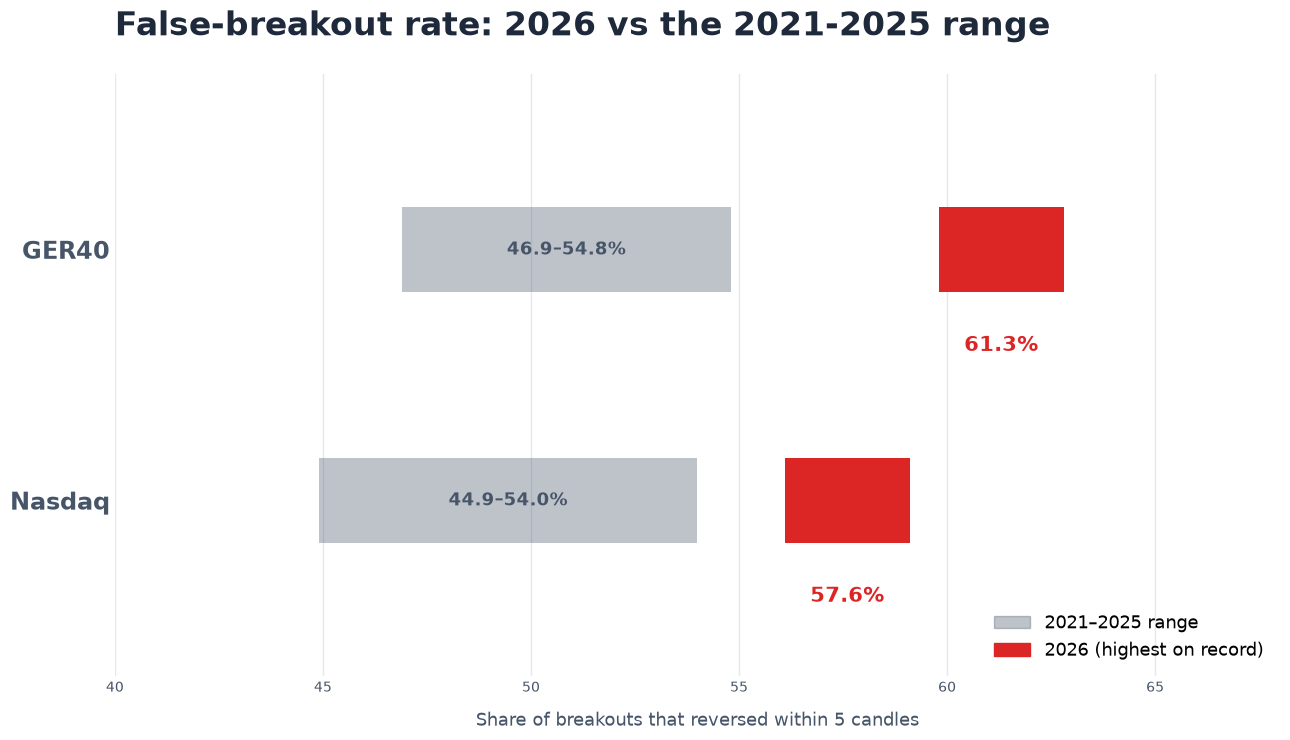
Bar chart comparing 2026 false-breakout rate against the 2021-2025 range for GER40 and Nasdaq, both at record highs in 2026

Breakouts are failing more often in 2026, and the data backs it up

I test a lot of systems against historical data, and most of the time the goal is finding an edge to trade. Every so often, the more useful thing that falls out is a measurement instead of a strategy, and this year handed me one that says more about the market itself than any strategy could: breakouts on GER40 and Nasdaq have been failing at a higher rate than at any point in the data I’ve got. ...

August 21, 2026 · 3 min · Clear Head Trading

Trader Interview: Kiwi — Nearly Full Time Trader

Part of an ongoing trader interview series — the same set of questions put to different traders, covering background, psychology, strategy, and lessons learned. Originally published on Traders Questions. Nearly full time trader — but have a farm and a deli business to run too. About yourself Started trading approximately 12 years ago but scaled back due to other commitments. Re-entered the field 3-4 years ago, experienced difficulty in the first year, then achieved steady progress. Now generates income through trading activities. ...

June 5, 2025 · 5 min · Clear Head Trading
Questions, feedback, or work enquiries — email me
This site is run by a private trader and reflects personal opinion and research, not financial advice — nothing here is a recommendation to buy, sell, or otherwise trade. Trade your own account and manage your own risk. Data, ratings, and trust scores in the Prop Firms section are compiled from public sources, independent reviews, and our own research — they are not verified guarantees of any firm's terms, financial stability, or conduct, and rules and pricing change frequently, so always confirm current terms directly with a firm before purchasing a challenge. Some links on this site are affiliate links, at no extra cost to you. This site uses cookies for analytics and, via affiliate links, for referral tracking on partner sites — see the Privacy Policy for details.