Position Sizing

Position size decides how much a single trade can cost, and it’s the one number in a trading plan that shouldn’t be guessed at or picked out of habit. It’s an output of two other numbers, not a decision made on its own. The formula Position size = risk amount ÷ stop distance. Decide how much money the trade is allowed to lose, decide how far away the stop needs to sit based on the chart, and the size that connects the two is arithmetic, not a feel. ...
3 min · Clear Head Trading

Stop Loss Placement

A stop placed at a round number of pips protects nothing if that distance sits inside normal price noise. A stop that respects whatever invalidates the trade protects it, even when that turns out wider than a trader would like. What invalidates the idea The stop belongs at the point where the reason for being in the trade stops being true, not at a distance that felt comfortable when the order went in. A breakout trade is invalidated if price falls back below the level it just broke; a pullback entry in an uptrend is invalidated below the swing low the pullback bounced from. Structure decides the location. Comfort doesn’t get a vote. ...

3 min · Clear Head Trading

Risk to Reward Ratio

Win rate gets talked about far more than it deserves. Risk to reward is the number that decides whether a strategy makes money, and understanding it properly matters more than treating it as a vague “good ratio” you’re supposed to aim for. The maths Entry in the middle, risk below (red), reward above (teal). Here the reward is roughly three times the risk. ...

3 min · Clear Head Trading

Daily Loss Limits

Most of the damage in a bad trading day doesn’t come from the first loss. It comes from what happens after it, when a trader tries to win the loss back and takes trades they wouldn’t normally take on a calmer day. Why the limit exists A daily loss limit interrupts that pattern. Once losses for the day hit a number decided in advance, trading stops for the day regardless of how good the next setup looks, because the state of mind that follows a string of losses makes “how good it looks” an unreliable judge in the first place. ...

2 min · Clear Head Trading

Account Management

Every trade gets planned around its own risk and reward, but an account can still get into real trouble even when every individual trade was managed properly. The thing that needs managing is the exposure across all of them together, not each one in isolation. Total exposure, not just individual risk Three trades each risking 1% looks conservative on paper, but if all three are long GER40, long the Dow, and long a correlated part of a portfolio at the same time, a single macro move against risk assets hits all three at once. The real exposure that day is closer to 3% than 1%. Correlated positions need to be sized as a group, not as three separate 1% decisions that happen to move together. ...

3 min · Clear Head Trading

Prop Firm Risk Rules

A funded evaluation adds rules a personal account never has to deal with, and most breaches don’t come from one big reckless trade. They come from a trader who plans around their own risk tolerance and forgets the account is running by different rules than they are. The usual three rules Most prop firm evaluations combine a daily loss limit, a hard cap on losses within a single day, usually 4-5% of account size, a maximum overall drawdown, a hard cap on total loss from either the starting balance or the account’s peak, commonly 8-10%, and a profit target, a required gain, often 8-10% for the first phase and sometimes lower for a second one, to pass. Every firm sets its own numbers, but that basic shape, daily limit, max drawdown, profit target, is close to universal across the industry. Compare rules across specific firms on the prop firms comparison tool. ...

3 min · Clear Head Trading

Compounding

A trader who makes a modest, consistent return every month, and never blows up the account in between, ends up ahead of a trader chasing bigger swings who occasionally wipes out a chunk of it, even when that second trader’s best months looked more exciting along the way. Compounding rewards consistency over size Gains compound on whatever the account currently holds, so a smaller return sustained over many periods outgrows a larger return that gets interrupted by one big loss. The big loss doesn’t just erase that period’s gain, it erases the base the next gain would have compounded on. ...

3 min · Clear Head Trading
Bar chart showing the share of retail traders who lost money across four studies: SEBI India, Brazil day traders, US households, and Taiwan day traders

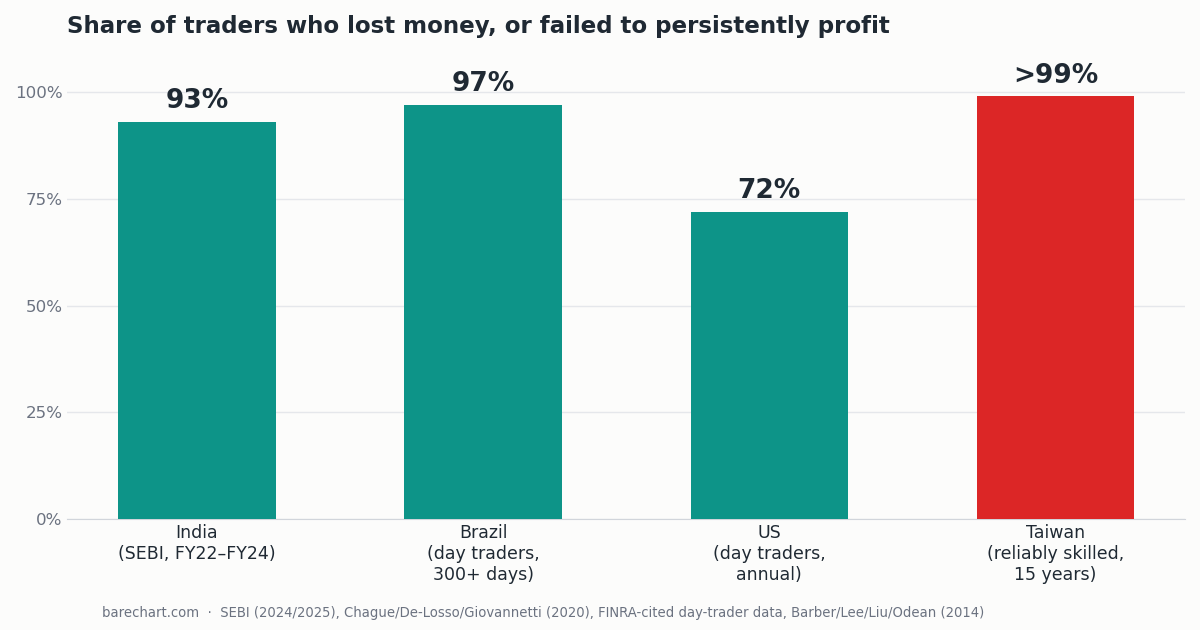
Most traders lose money, and the numbers point at psychology, not strategy

Ask most traders why they’re not profitable yet and you’ll hear about strategy: the wrong indicator, a system that needs more backtesting, a market that’s stopped behaving the way it used to. Look at the actual research on who wins and who loses, though, and strategy barely gets a mention. The regulators and academics who’ve measured this properly, across different decades, different countries, and completely different market structures, keep landing on the same answer, and it isn’t a strategy problem. ...

August 26, 2026 · 6 min · Clear Head Trading
Questions, feedback, or work enquiries — email me
This site is run by a private trader and reflects personal opinion and research, not financial advice — nothing here is a recommendation to buy, sell, or otherwise trade. Trade your own account and manage your own risk. Data, ratings, and trust scores in the Prop Firms section are compiled from public sources, independent reviews, and our own research — they are not verified guarantees of any firm's terms, financial stability, or conduct, and rules and pricing change frequently, so always confirm current terms directly with a firm before purchasing a challenge. Some links on this site are affiliate links, at no extra cost to you. This site uses cookies for analytics and, via affiliate links, for referral tracking on partner sites — see the Privacy Policy for details.